Rethink 'traffic congestion fees'
The Beijing environmental authorities recently issued an action plan to improve the city's air quality and asked relevant departments to discuss the possibility of collecting "traffic congestion fees" to reduce pollution, which has been questioned by many, says an article in Guangming Daily. Excerpts:
The Beijing environmental authorities have adopted a series of measures in recent years to ease traffic congestions but still failed to substantially improve the situation. The traffic congestion problem in Beijing is the result of highly concentrated public resources in the city and severely imbalanced distribution of its functional areas.
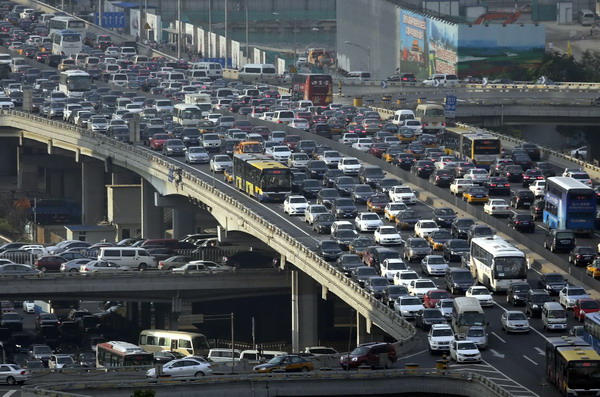
Lines of cars are pictured during a rush hour traffic jam on Guomao Bridge in Beijing. [Photo/Agencies]
The urbanization drive in China has made cities increasingly bigger. On the other hand, employment opportunities, and healthcare and education facilities in the satellite cities and suburban areas are still inadequate, widening the distance between people's homes and workplaces.
Therefore, the need to devise a scientific and workable plan to improve opportunities, and public amenities facilities has become more important than ever to ease the traffic congestion problem in cities.
When it comes to imposing the proposed "traffic congestion fees", the authorities have to decide whether public transport vehicles will also have to pay them and who foots the bill. If taxpayers end up paying the "traffic congestion fees" for public transport vehicles, that would be social injustice. In this sense, the proposal to impose "traffic congestion fees" is part of not only an environmental policy, but also a social policy.
Many people who support the proposed fees will cite the examples of the models followed by countries such as Singapore. But since Beijing is a mega-city with a population of 20 million, it would cost an astronomical amount of money to build a public transportation system as convenient as that of Singapore.
The impact of public policies will be different on different social groups. Hence, the authorities must solicit the opinions of all social groups before implementing a social policy. Only if all social groups are taken into confidence can a social policy prove truly successful upon implementation.
(China Daily 09/18/2013 page9)