Better protecting human rights
Editor's Note: More than 100 experts and officials from home and abroad are participating in the Sixth Beijing Forum on Human Rights, being held in Beijing on Thursday and Friday, with building a sustainable environment for human rights development as the theme. The following is selected views from some of the participants on major topics.
Chinese dream and human rights
Li Junru, vice-president of the China Society for Human Rights Studies and former vice-president of the Party School
The Chinese dream is a human rights dream combining social improvement and economic development in the course of realizing Chinese people's rights to subsistence and development.
The Chinese dream is also a human rights dream integrating the dignity of a nation and the dignity of each of its citizens. History has proven that without the dignity of the state and nation, an individual cannot gain personal dignity, and a nation won't get dignity from the outside world if it doesn't respect and protect the personal dignity of its citizens.
China's modernization and peaceful development have demonstrated Chinese people's basic viewpoints on human rights, that the rights to subsistence and development are the most fundamental human rights.
We have recognized that we must not only insist on promoting modernized productivity and economic development, but also persistently accelerate social improvement in order to build a vigorous, harmonious, and culturally advanced society.
One important task we should undertake in social construction is to proceed from reality and gradually resolve all kinds of problems concerning the people's livelihoods.
Political rights vs economic and social rights
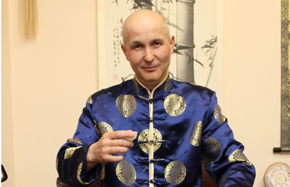
Otto Kolbl, researcher at the German Department of the Lausanne University, Switzerland
The international community, working within the framework of the United Nations, has time and again emphasized that civil, political, economic, social and also cultural rights are all integral and indivisible parts of human rights.
However, recent research has confirmed that Western politicians, human rights experts and media tend to exclude economic and social rights from their discourse. The right to economic development in particular is not only excluded from human rights, it is often set in opposition to "human rights development", despite the fact that it is mentioned explicitly in several fundamental human rights texts.
The right to life is considered by most people and experts to be the basis of all human rights: of civil and political rights, as well as the economic and social rights. In developing countries, people are aware that poverty kills. It is therefore not surprising that not only the right to healthcare, but also the right to a "continuous improvement of living conditions" is explicitly mentioned in the fundamental human rights texts. Unfortunately, Western human rights experts seem unable to look beyond the wealthy and highly industrialized society in which they live.
The Western human rights discourse consisting in an exclusive advocacy of the civil and political rights is based on a lack of understanding of the basic UN human rights texts, of conditions in other regions of the world, and of the relationships between the various rights.
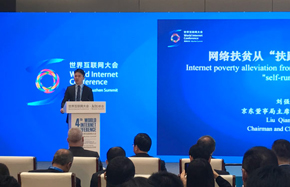
Holden Chow, chairman of the Young Democratic Alliance for the Betterment, Hong Kong, China
China's emphasis on human rights is not limited to civil and political rights; it is also linked to economic, cultural and social aspects. During its social construction, China is focused on protecting and improving people's livelihoods, further improving the basic public service system, significantly upgrading the basic public services and the degree of equalization, and promoting the rapid development of education.
However, we must understand that due to China's huge population, complex environment, and the relatively low education level of the population, the duplication of Western society will have unimaginable consequences in China and affect social stability and people's lives.
China should make steady progress along its own development path, so as not to lose its direction. In this context, China should possess a greater tolerance toward criticism and gradually correct some drawbacks, in order to achieve a better future for the nation and the people.