Parents go from tangerines to laptops
A railway station in a city. A 20-year-old man is leaving for Peking University. He fails to dissuade his father from crossing the railway tracks and clambering up and down platforms to reach fruit vendors outside the station. The father, though stout, staggers all the way back with some tangerines and gives them to his son. He pats the dirt off his clothes with a somewhat relieved look and says after a while: "I must go now. Don't forget to write me from Beijing." The son looks at his father's retreating figure mixing into the bustling crowd, with tears welling up in his eyes and blurring his sight.
The parting scene in prominent writer Zhu Ziqing's well-known essay, Beiying (Retreating Figure), has touched the heart of generations of Chinese people, with the tangerines symbolizing the profound love parents have for their children and smoothing one of the biggest transitions in life.
In the coming days, millions of Chinese parents will send their children to college. But both the times and the situation that Zhu so eloquently captured in his essay have changed. Today, many parents accompany their children all the way from home to their campuses tugging their heavy luggage behind.
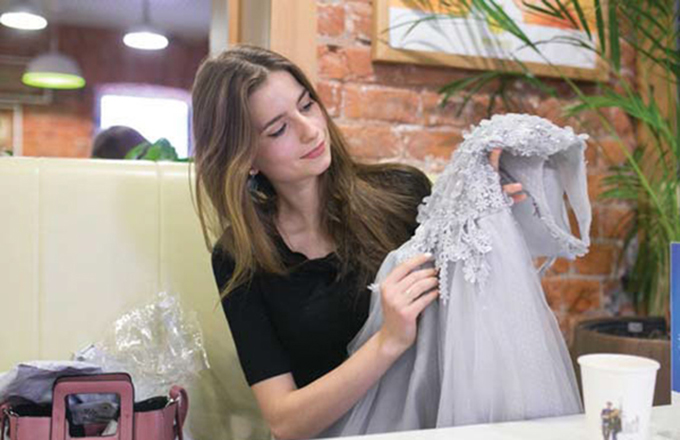
In recent years, the period between late August and early September has become a season for back-to-school shopping by freshmen and their parents with electronic products being the most sought after objects.
Apart from the traditional college expenditure, which includes the tuition of about 5,000 yuan ($817) a year, plus boarding fee and the living costs, it is estimated that parents spend more than 10,000 yuan on products like smartphones and laptops, as well as beddings and apparels and other must-have gadgets for an average college student.
Some critics are worried that the back-to-school shopping craze may turn into a battle and create an even wider psychological gap between students from affluent families and those continuing their studies on student loans. Indeed, some families think it's worth helping their wards with money, even if they have to borrow it, to keep up with the children of the Joneses in possessing whole sets of Apple devices.
However, for most families, compared with the keeping-up-with-the-Joneses psychology, the back-to-school shopping is more about the sense of security for parents who would feel they have paved the way for the college-going children, even though they are unable to control how well their children perform in school.
Likewise, in recent years, many Chinese parents have loosened their purse strings even for plastic surgery that their children want to undergo before entering college, because they believe an eye or a nose job that can make their children look better will increase their employment prospects and bring other opportunities.
Unfortunately, this year is said to be the toughest for new college graduates to find a job, partly because the economic slowdown has reduced the number of job vacancies. Given the situation, the future of the class of 2017 doesn't look too bright.
Macroeconomic factors, however, have not had the expected impact on Chinese parents' spending decisions, at least not until now. The amount that goes into building a child's future is still deemed worth every penny spent according to the Chinese parenting philosophy that you can't be too generous when it comes to children's education.
This may be good news for retailers devising ways to increase their sales. However, it does not necessarily mean retailers can become the biggest winner and parents the biggest loser, as many would fear.
After all, the generous spending helps both parents and children prepare for a smooth transition from high school to college. It serves as a sort of mental rehearsal for the separation between parents and children, which embodies parental affection just the way a few tangerines did almost a century ago.
Parents feel less anxious and more secure with the transition when they fill their college-going children's luggage with brand-new products and imagine the kids using them on campus.
Nevertheless, it does not mean that the more expensive a product is, the better it will be. A renewed sense of thrift will in no way undermine parental affection. Parents and children can still stay connected through shared activities, deciding, for example, what items can be reused and what new products really need to be bought depending on the family's financial resources. This would give everyone a chance to reach a new level of independence upon the transition.
The author is a writer with China Daily. E-mail: gaozhuyuan@chinadaily.com.cn
(China Daily 08/30/2013 page7)