Tough policy not to last long
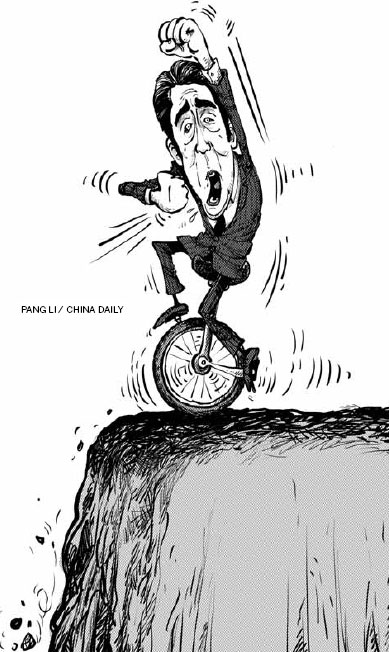
Japanese Prime Minister Shinzo Abe's ruling coalition scored a decisive victory in the upper house election on Sunday. But he should not mistake the victory as Japanese people's approval for his hawkish foreign policy. Abe's victory can be attributed largely to the short-term effect of his economic policies, which some experts have named "Abenomics", and the lack of an appealing alternative to the Liberal Democratic Party.
Abe's understanding and ideology not only reflect his "indifference" and "ignorance" of history, but also highlight his "rightist" stance and intention of making Japan a military power again. Abe's statements and actions, from doubting the validity of the Tokyo Trials, challenging the post-World War II international order and regarding the atrocities committed by Japan's former militarists as "proud history" to exaggerating China's military threat and trying to revise the country's pacifist constitution in order to exercise the right to collective self-defense, show that he is dead set against China.
In the run up to the election, Abe got more belligerent, vowing not to concede even an inch to China in the Sino-Japanese dispute over the Diaoyu Islands. His was a politically pregnant move aimed at cashing in on Japan's overall right-leaning atmosphere to win the election.
Now, with a majority in both houses of Japan's bicameral parliament, Abe is expected to act tougher against China.
However, in the long run, Japan is highly unlikely to contain the rise of China. On the contrary, a series of domestic and international factors will limit Japan's aggressive moves and compel it to again adopt a cooperative and engaging approach toward China on the whole.
Two major domestic problems will prevent Japan from containing China's rise. Politics and the bureaucracy are the first. In a debate held at the Japan National Press Club sometime ago, eight other party leaders asked Abe to explain his economic policies, and give his views on revising Japan's constitution and ties with China. They also asked him to clarify his stance on Japan's wartime history.