Prepare for exit-QE shockwaves
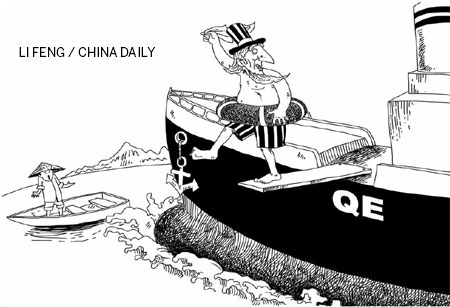
The three main economic issues discussed at the fifth Sino-US Strategic and Economic Dialogue in Washington last week were increasing bilateral trade, facilitating structural reforms and enhancing cooperation in financial markets. The most important financial issue for the world's two largest economies, however, is how to deal with the possible effects of the withdrawal of the US' quantitative easing (QE) policy.
The US economy is showing signs of stable recovery. In 2012, the housing market performed much better, with the Federal Home Loan Mortgage Corporation (Freddie Mac) making a profit of $10.98 billion, the first since 2006. The employment rate, too, has improved in the US.
Besides, the impact of QE on the US' economic recovery is waning and its ill-effects - creating a property bubble - is becoming more evident by the day. That's why the US might taper it off. But the tapering off of the QE policy could trigger huge capital flows and lead to another debt crisis - just like its introduction did - and the emerging market economies will be first to suffer its impact.
Repercussions of the US' economic policies across the globe abound in history. In 1971, following the Nixon Shock - a series of economic measures taken by the US including the decision to unilaterally cancel the direct convertibility of the dollar to gold - the main Western economies entered into a competition to devalue their currencies that led to a decade of "running inflation". Since the interest growth rate lagged behind the currencies' depreciation rate, the effective interest rate from 1975 to 1980 was zero - while from 1970 to 1980 it was 0.4 percent and the London InterBank Offered Rate from 1974 to 1977 was below zero.
Some countries, including those ideologically opposed to the Western world, tried to exploit the "opportunity" offered by the Nixon Shock. For instance, the Soviet Union made the use of foreign capital a national strategy, introducing $17.661 billion of Western capital during its Ninth Five-Year Plan period (1971-1975). Of the total foreign capital, 82.3 percent was introduced in the last three years of the plan period.