Japan arms its way out of crisis
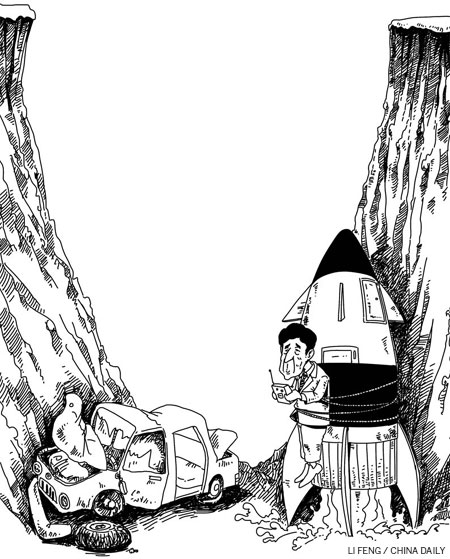
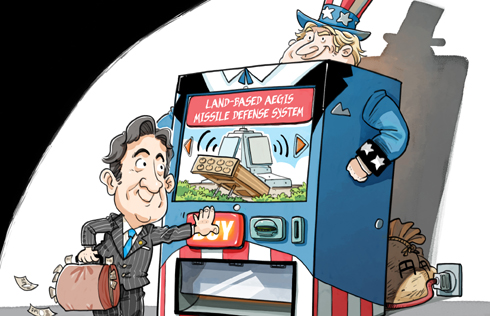
Since assuming office in December, Japanese Prime Minister Shinzo Abe has been trying desperately to pull the country's economy out of its long-drawn deflation to consolidate his Liberal Democratic Party's position in parliament. Inspired by the United States' quantitative easing (QE) policy, Abe has introduced an economic policy consisting of "three arrows" - an aggressive monetary policy, massive fiscal stimulus and structural reforms - which economists have labeled "Abenomics".
But even after firing the first "two arrows", Abe has been achieved little.
As rumors of the US ending QE3 began in May, it triggered turbulence in the global financial market and Japan's stock market began slumped. On June 13, it plunged 6.35 percent, the biggest fall since the devastating 2011 earthquake and tsunami, with Nikkei 225 closing at 12,445.38 points. And even after Abe fired the "third arrow" of structural reforms on June 14, the stock market has not recovered.
Instead of bringing tangible benefits to Japan, Abenomics has pushed it deeper into debt. According to latest statistics, the Japanese government's debt is projected to increase from 991 trillion yen ($9.9 trillion) at the end of 2012 to more than 1,000 trillion yen at the end of this year. That indeed is a huge amount of debt.
Japan's aging and dwindling population, sluggish economy, and declining private savings and salaries are also pulling back the economy. Worse, Japan's energy imports have increased substantially since the 2011 earthquake, because it was forced to shut down many nuclear power plants after the quake and tsunami damaged the Fukushima Daiichi nuclear plant that triggered a deadly leak.
Moreover, the devaluation of the yen has led to trade deficits for 10 months in a row for Japan, and the country could find itself mired in dual deficits - current account deficit and trade deficit - in the near future.
Although Abe claimed at the recent G20 meeting that he would reduce Japan's fiscal deficit by half by 2015 and achieve surplus by 2020, he will find it difficult to do so if he raises the consumption tax. Therefore, it seems Japan is headed for a fiscal cliff.