Global IT and techno-jingoism
By 2020, the world will have about 50 billion connected electronic devices. We will have our own smartphones and computers, and organizations will have them spread everywhere from offices to tractors and boats to planes, monitoring rivers, air and soil.
To start understanding what this means, think of cellphones. About 1.75 billion sets were sold in 2012, and Samsung and Apple together took up 52 percent of the smartphone market's share in the fourth quarter of last year. But despite that, the big business and long-term dominance of wireless network equipment is with Ericsson -38 percent globally. The sales of Ericsson's cellphone may have dropped to a few percent, but the company has a century of history in infrastructure network, which, unlike cell- phones, cannot be changed according to our whims and fancies.
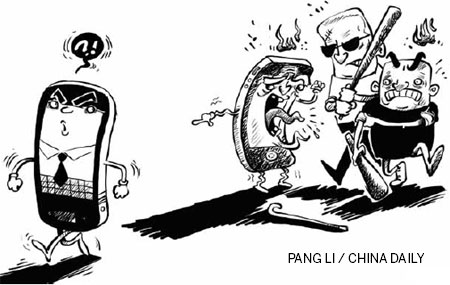
China's two wireless network equipment companies, Huawei and ZTE, have changed from minor players to global giants in a few years. It is this phenomenon that has prompted some people to use techno-jingoism to thwart the two companies' attempts to invest in the United States and European Union countries. Their rationale is as ridiculous as the corny plots of some old James Bond movies in which Chinese were depicted as the bad guys.
The simple fact is that, as a spin-off from the three-decade GDP growth miracle, Chinese entrepreneurs have hit the ground at speed with confidence and vigor. And like Haier in household appliances and Lenovo in PCs, Huawei and ZTE have rocketed to the front after learning hard lessons from Western companies and spreading throughout China's regions before going national and global.
The Huawei CEO is justified in boasting that the company has 140,000 hardworking, well-trained, motivated workers in 140 countries, and it innovates technologies and improves management systems. While "only" 27.2 million Huawei smartphones were sold in 2012, the year-on-year increase was 73.8 percent.
More to the point, and worryingly for Ericsson, is the fact that Huawei network services have pioneered "integrated revenue and customer management", which is very attractive to customers and encourages end-to-end technology purchase rather than large customers buying segments that don't match.
If the core industry in a new greenfield development project in western China - such as a mine or oilfield - and attendant agriculture, water, power and transportation sectors are all part of a Huawei network, their efficient operational management and transparency would show how disjointed are the monitoring and management of a city whose different departments use different servers.