Looking for real film co-production
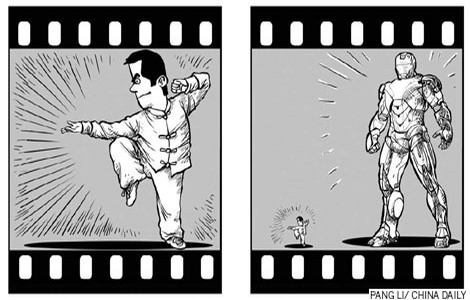
Of late, big Hollywood studios have been trying to reach out to Chinese audiences by adding Chinese elements to their productions. But even then such Hollywood films are far from real co-productions because the Chinese elements are simply "decorations" aimed at boosting their appeal in the lucrative Chinese market.
For Hollywood studios, the Chinese market has become increasingly important. China is the world's second-largest film market and has the potential to be the largest. And US producers are adjusting to this fact by trying to "please" Chinese audiences by including popular Chinese actors and adding familiar Chinese elements to their films.
Thirty-eight Hollywood movies were screened in China last year, among which actress Xu Qing played a role in Looper, and Jet Li and actress Yu Nan were part of The Expendables 2 cast. This year has seen actress Zhou Xun playing a role in Cloud Atlas, for which Dreams of the Dragon Pictures was one of the investors and distributor for the Chinese region. And in Iron Man 3, extra scenes featuring actress Fan Bingbing and actor Wang Xueqi, and several Chinese brands were added for the Chinese version.
According to the State Administration of Radio, Film and Television, a film is considered a co-production if the Chinese partner provides more than one-third of the total investment, a Chinese actor or actress plays one of the main characters and most of the shooting takes place in China. If a Hollywood film meets these criteria, it will be considered a "domestic film" and will not be included in China's import quota for foreign films. And like domestic films, it can take 43 percent of the box office, a significant increase on the 25 percent share of imported films.
But even when Chinese companies are involved in the production or account for part of the budget, they hold only part of the production process and their returns come from the domestic market, not the global market. Therefore, they are not true co-productions. Even China Film Group, one of the companies that produced the new The Karate Kid (starring Jackie Chan and Jaden Smith) - a movie about an American boy learning kung fu in China and mostly filmed in China - restricted itself to the domestic market by not participating in its global distribution.
Hollywood studios have drawn a fine line between having enough Chinese elements to appeal to Chinese audiences and too many to alienate audiences in other markets, especially the US, which is still their biggest market.
"Hollywood studios cannot give up the rest of the market just to win over Chinese audiences," says Peng Kan, research and development director of Beijing-based consulting company Legend Media. "Using too many Chinese stars and other Chinese elements may make a film unacceptable for viewers in other countries, which Hollywood doesn't want."