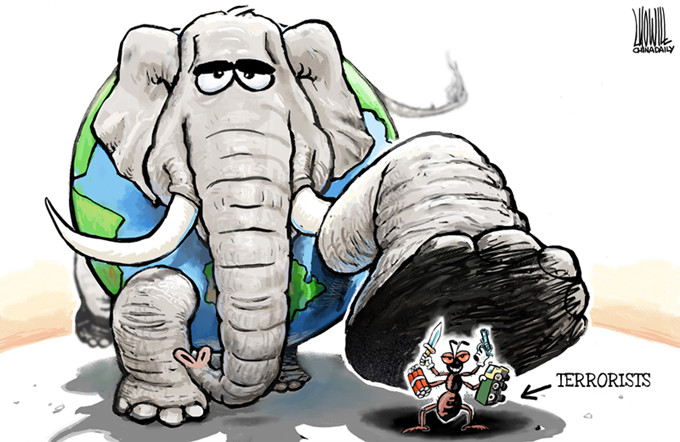
Boston attack will not change US strategy
Many US citizens were dissatisfied with the Bush administration's war on terror, as it not only cost the country a huge amount of manpower and financial resources, it also worsened relations between the US and its traditional allies and resulted in the US neglecting many other regions in the world that deserved attention. The Obama administration has learned a lesson from this, and there are many rational and pragmatic senior officials in the Obama administration who are willing to spend whatever money they have more wisely and efficiently.
The Boston terrorist attack hasn't fundamentally changed the international situation and the main challenges the US faces. The Obama administration introduced the return to the Asia-Pacific strategy, because they realized the Bush administration paid too much attention to the Middle East while ignoring the more important Asia-Pacific region.
Nowadays the Asia-Pacific region is the fastest developing and most energetic region in the world, and it is also the most important region for the US as it tries to kick-start its economy. But territorial disputes and nuclear issues in the region have had a great impact on the US' traditional Asia-Pacific strategy.
More importantly, the emerging of China and India has far-reaching potential to impact on the region. Domestic terrorist attacks can at most interfere in the US' security environment, but they will hardly be able to have deep impact on its national security framework in the future. With the strategy of returning to the Asia-Pacific in place, the US will not change its strategic planning just because of a small terrorist attack, despite the fact it was on US soil.
Hence, the Boston terrorist attack will not draw Washington's focus from the Asia-Pacific region.
However, the rebalancing to the Asia-Pacific is not at the expense of the Middle East. The US never intended to withdraw completely from the Middle East, and it will continue to engage with both the Middle East and the Asia-Pacific, while giving priority to the Asia-Pacific.
The author is a researcher with the Institute of American Studies, affiliated to the Chinese Academy of Social Sciences.
(China Daily 05/14/2013 page8)