The science of quake relief
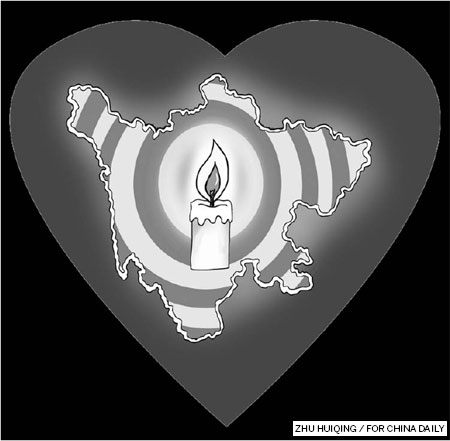
Premier Li Keqiang stood among the rubble of what had been an old dilapidated shack on a steep slope and stressed to the rescue team, and more importantly the whole world via TV, that earthquake aftereffects must be addressed by scientific means. The contrast between modern science and what used to be poor, simple shelters was striking. An obvious manifestation of the premier's intent was the lightweight special purpose scanners that could detect heat or movement or faint sounds of villagers trapped under debris (and perhaps unconscious).
But science goes much further than that in addressing earthquake issues. The first reality check is the need to understand the physical dimensions of the setting. Ya'an, Lushan and Baoxing (in Sichuan province) are not just names on maps. For those not in the know, and this especially applies to many foreigners, it is quite misleading to quote the official statistics that "Ya'an city has a population of 1.5 million and an area of 15,398 square kilometers".
With Google Earth we can quickly and for free fly over the area and understand that the main urban settlement of Ya'an is on lowlands and is small, just a few kilometers across. Following the road winding upriver is the county of Lushan, which again has a tiny set of streets with that build-up area called Luyang. Further upriver, through a steep sloped valley is the county of Baoxing, with a "main village" of Muping. Becoming scientifically intelligent through Google Earth or, for better-resourced specialists, lots of satellite and aerial imagery can greatly improve understanding and lead to efficient post-disaster operations.
But that understanding begins with access to and out of the danger area, and clearly some well-intended rescuers had no idea of the road conditions and the likelihood of landslides and rocks blocking their way. Moreover, with Lushan publicized as the epicenter of the quake, and easier to access than Baoxing, the latter went almost unattended by the first wave of rescuers. Baoxing has about 50,000 people, compared with Lushan's 120,000. It is poorer, too, and any building not on the county's scanty flat areas is in danger of collapsing down a slope.
There is another new science that the premier demonstrated and left with the rescue and development organizations. It is the discipline of scientific management, a fairly new concept in the developed world, and unimaginable to the earlier Chinese leadership. With access to unprecedented detailed data on topography, geology, weather, water science, plus economic and demographic statistics, China's new leadership must operate with the computer software of logical project planning. This enables all actions to be balanced, coordinated and synchronized.
Taking a step back from the urgency of the past few days' tragedy and mayhem, China can reflect that it has come a long way from May 2008, when schools in Sichuan's Wechuan county must have been built outside regulations and crumbled easily with deadly results. Google Earth can show Wenchuan in January 2008 and then in a series of more recent shots graphically illustrate the positives that came out of the disaster. Wenchuan lies on the same fault-line that streaks down to Lushan, obvious on Google Earth. Science would strongly suggest that other settlements on that line have to tend to the building codes.
There is another startling scientific lesson to be learned from the April 20, 2013, earthquake in this remote region that rises off the Sichuan Basin toward the Qinghai-Tibetan Plateau. Economists and journalists tut-tut about China's Gini coefficient and the widening gap between the rich and the poor. Apart from that single index, we can also see in cities poor waste-gatherers against the backdrop of skyscrapers. But the TV images of the poor people in the remote mountainous regions, and the loss of the little they had, is a wakeup call to those who have more than enough and still want more.
It is heartening, though, to see that many do want to give but to not rush there and clutter the roads and instead simply donate cash. The Red Cross is a magnificent global institution, and East Asia director Martin Faller is leading the way for NGOs on Lushan relief, and cash has been the best way to help. If the poorest villagers are living examples of the one extreme on the Gini coefficient graph, then at the other end was Guo Meimei. The spoilt brat, molly-coddled by her rich divorcee mother, sullied the image of the Red Cross some time ago with her vulgar online display of wealth and "dubious" connections.
Red Cross support fell briefly under the frenzy of unfounded online criticism that her actions evoked from the public. But most people are wiser today - they can tell who is on which side of the Gini coefficient and who needs help and attention and who should be avoided and ignored - which is good news for the Lushan quake survivors.
The author is an Australian researcher collaborating with Chinese academic and commercial institutions.
(China Daily 04/24/2013 page9)