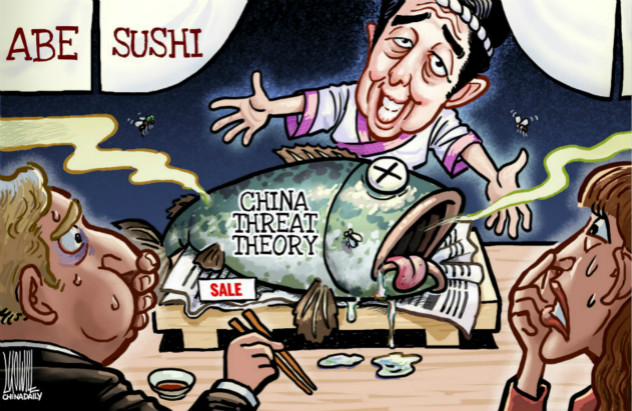
'Abenomics' may not cure Japan
Theoretically, a sharp depreciation of the yen against US dollar can boost the revenues of export-oriented Japanese companies and make shareholders richer. But based on the short-term economic measurement of Japan's Cabinet Office, it is hardly possible to meet the 2 percent inflation target before 2014.
Moreover, Japan's move to devalue the yen will have serious repercussions on its major trading partners. Official data show that Japan's exports reached $801.28 billion in 2012, higher than 2011, but then its trade deficit reached a record $87.11 billion, an increase of $54.83 billion.
Japan's trade deficit has increased because of the decline in exports to its major trading partners such as China and the European Union. Japan's decision to "purchase" the Diaoyu Islands has cast a shadow on Sino-Japanese trade ties and reduced Japanese exports to China. In 2012, Japan's exports to China declined by $16.76 billion from the previous year, and its trade deficit with China rose to 51.8 percent of the total. In addition, the debt crisis in the EU has led to a decrease in imports from Japan. Last year, Japan's exports to the EU dropped by $13.67 billion from 2011.
Thus by inference, we can say that increased exports to its major trading partners like China and the EU will help Japan's economic revival.
The Japanese media have been saying that many countries reduce corporate tax in their fight against economic hardships. This is done to encourage enterprises to recruit more people in the hope of mitigating social conflicts and enhancing economic growth.
Though this is the first time that the Japanese government has offered to reduce corporate tax for companies that increase workers' salaries, it seems too hasty a decision given that the yen started depreciating just three months ago. This raises doubts over the effectiveness of "Abenomics" to sustain Japan's economy even in the long run.
Former Japanese prime ministers Nobusuke Kishi (in the 1950s) boosted economic growth by improving the pension system and Ikeda Hayato (in the 1960s) propelled the economy through his income-doubling plan, and both have left a mark in Japanese history.
Abe is trying to enter the history books by reviving Japan's economy through his plans to increase workers' salaries and seek a stable, long-term rule for the LDP. But no matter what he does, his success will depend on improving trade and diplomatic relations with China.
The author is a researcher with the Chinese Academy of International Trade and Economic Cooperation under the Ministry of Commerce.
(China Daily 04/03/2013 page9)