US creates friction but needs cooperation
Now he has begun his second term in office, one of US President Barack Obama's top priorities is creating jobs.
Stephen Roach, former chief economist at Morgan Stanley, has forecast a weak economic recovery for the United States in 2013 and described the US' high unemployment as "a dangerous signal" for relations between the US and China, as China will remain the scapegoat for job losses and factory closures in the US.
As the federal deficit is still running high and interest rates have dropped, there isn't much room for the Obama administration to maneuver. The only option seems to be expanding exports. US exports to China have grown by 59.2 percent over the past three years and are expected to grow by 12 percent in 2013. Hence, the US must focus on expanding sales to China. There will be continuous pressure on China's trade policies during Obama's second term, and US trade remedies on imports from China can also be expected to intensify.
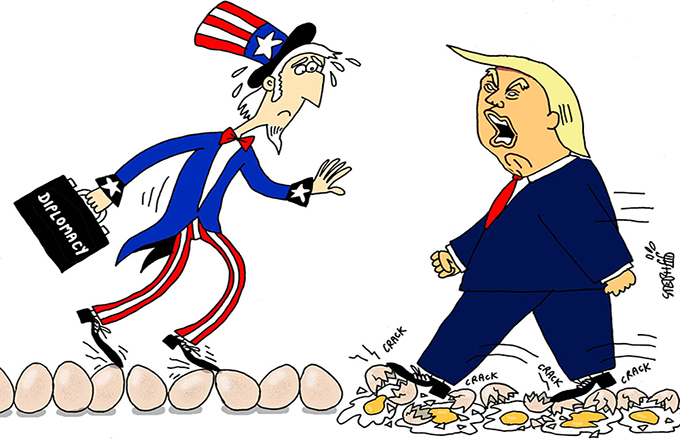
To aggravate the situation, discord with China's economic system is gaining momentum in the US, creating strong strategic distrust. US-China trade frictions have been extended from specific products and sectors to the overall economic system. It is likely the Obama administration will target China's whole economic system and government role in the economy.
While continuing bilateral consultation, the Obama administration will resort to plurilateral and multilateral trade mechanisms. The US will resort to World Trade Organization dispute settlement on individual cases with China, and energetically push regional free trade agreements, with the primary objective being a framework agreement on the Trans-Pacific Partnership by the end of 2013. Obama will also seek to upgrade the North American Free Trade Agreement and initiate the Transatlantic Partnership, with a view to creating a new, advanced template of trade rules for the world that is to the US' advantage.
China, on the other hand, will uphold the Doha Round of trade negotiations at the global level, and at the regional level promote the Regional Comprehensive Economic Partnership - between the 10 members of the Association of Southeast Asian Nations, plus China, India, Japan, South Korea, Australia, and New Zealand - and China-Japan-South Korea FTA talks.
However, the Obama administration, while maintaining and even intensifying frictions, will also seek more practical cooperation with China, covering two-way trade and investment, finance, Internet services, education and tourism. According to Rhodium Group, a New York-based consulting company, Chinese direct investment in the US was estimated at $6.5 billion in 2012, breaking the previous record of $5.8 billion in 2010. Conversely, foreign direct investment inflows into the US from the European Union and Canada fell by around 50 percent compared to five years ago.
Meanwhile, various US states are competing with each other for Chinese investments. The political obstacles, while persistent, will not change this general trend. It can be expected that Chinese annual direct investment flows into the US will surpass $10 billion and total investment stock will hit $50 billion before the end of Obama's second term, creating roughly 100,000 US jobs and supporting the development of clean energy and advanced manufacturing. Similarly, US direct investment in China grew by 4.5 percent in 2012, when China's total global FDI inflows fell by 3.7 percent.
There are good opportunities for cooperation on shale gas, clean coal technology, smart grid, air pollution control, biotechnology, avionics, high-speed railways, and more. The astonishingly strong collaboration between leading US and Chinese IT giants on cloud computing and software services are some of the most convincing cases showing the mutual benefits of cooperation.
The US needs cooperation with China, and vice versa, as cooperation helps promote the economic interests of both countries. China is expected to replace the US as the world's largest import market during President Obama's second term. The huge Chinese market potential will undoubtedly serve as an anchor for bilateral trade. If US exports to China grow by 12 percent annually over the next four years, a total of 143,000 jobs could be created in the US.
The author is co-director of the China-US/EU Study Center at the China Association of International Trade. www.chinausfocus.com
(China Daily 02/26/2013 page8)