Comments()
  Print
Print  Mail
Mail  Large Medium Small
If China and US handle their trade relations well and cooperate while competing, they will certainly enjoy a win-win result
The 23rd China-US Joint Commission on Commerce and Trade, held in Washington on Wednesday, has sent a clear signal that the world's two largest economies will benefit from a serious, careful handling of bilateral trade issues.
The United States has said it will improve high-tech exports to China for civil purposes, which includes supporting cooperation in civil nuclear energy technology. Washington has also invited Chinese companies to invest in the US and enhance cooperation in intellectual property rights by providing resources to implement a bilateral framework.
China, on its part, has said it will strengthen its IPR framework to provide equal treatment to foreign and domestic companies for China Compulsory Certification and in strategic industries' development.
The commitments made by China and the US show that they share a common interest in a wide range of areas.
This year has seen a number of trade and investment frictions between China and the US, especially those related to solar cells, auto parts, Huawei/ZTE and Sanyi, and the accusations against China for "undervaluing" the yuan. Besides, the baseless charges leveled by US President Barack Obama and Mitt Romney, his Republican rival in the presidential election, on China's trade mechanism cast a cloud over the Pacific.
The US tends to persist with trade protectionism because its jobless rate is still above the normal 5 percent and its economic recovery is still foundering. And since the growth in the exports of Chinese capital-intensive goods poses a challenge to the US manufacturing sector, trade frictions are likely to continue.
However, this is only half of the Sino-US trade story. This year has also witnessed solid growth in actual business flows between the two countries. Chinese customs data show that Sino-US trade reached $438.62 billion in the first 11 months of 2012, up 8.2 percent year-on-year and 2.4 percentage points higher than China's global trade growth rate. China's exports to the US grew by 8.2 percent and its imports from the US by 8.1 percent, 0.9 percentage and 4.0 percentage points higher than its global export and import growth rates.
Official US figures show that in the first nine months of the year, its exports to and imports from China grew 0.8 percentage and 2.6 percentage points higher than its exports to and imports from the rest of the world. In other words, both countries have slightly increased their shares in each other's market.
In the first 11 months of the year, China's total inflow of foreign direct investment fell by 3.60 percent year-on-year because of the weak global economic recovery and the lingering euro debt crisis. But the FDI inflow from the US grew more than 6 percent. China's direct investment in the US, too, increased 13 percent year-on-year in the first 11 months of the year, according to the Ministry of Commerce.
The Chinese and the US economies are complementary in many respects, and the facts and figures above point to profound economic fundamentals underlying their trade relations. The fast growing Chinese market has driven and will continue to drive many American companies' growth. A recent US-China Business Council survey shows that the revenue growth of two-thirds of American businesses in China was more than 10 percent in the past year. Also, 75 percent of the US businesses had profits higher than their global average and 94 percent saw China as their top priority.
The US has now replaced the European Union as China's largest export market. It is also China's leading source of investment and high technology.
Moreover, Chinese investment in the US not only has generated tens of thousands of jobs and helped US exports, but also could create a win-win situation in the solar energy sector, which got entangled in a dispute because of Washington's trade policies. The mega investment project of a clean energy ecology center in Nevada, US, (which runs into $5 billion) by Chinese company ENN includes a huge solar power plant and solar cells' facilities. The project will not only create thousands of jobs in the US, but also build a new market for alternate energy and support a number of related industries.
Also, the US should know that IPR is not its top priority alone. The Chinese government accords it equal importance, because IPR infringements hurt both countries.
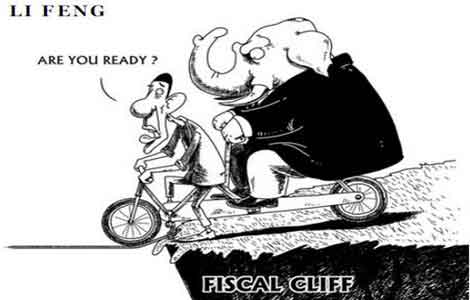
The 23rd China-US Joint Commission on Commerce and Trade has accomplished its task of keeping Sino-US trade relations on track. Experts say the US economy, if it avoids falling off the fiscal cliff, could register a slightly stronger growth next year.
The Chinese economy, meanwhile, bottomed out in the third quarter of 2012 and will gain some momentum next year. If the world's two largest economies handle their trade relations well and cooperate while competing, their complementary economic fundamentals are bound to yield a win-win result.
The author is co-director of China-US-EU Study Center, affiliated to China Association of International Trade.
(China Daily 12/22/2012 page5)
Copyright 1995 - 2010 . All rights reserved. The content (including but not limited to text, photo, multimedia information, etc) published in this site belongs to China Daily Information Co (CDIC). Without written authorization from CDIC, such content shall not be republished or used in any form. Note: Browsers with 1024*768 or higher resolution are suggested for this site.
License for publishing multimedia online 0108263 Registration Number: 20100000002731