Op-Ed Contributors
Is the wealth gap widening?
By He Bolin (China Daily)
Updated: 2011-04-14 08:02
 |
Large Medium Small |
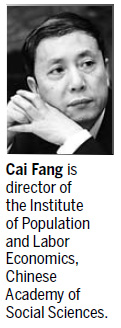
The wealth gap in China is wide. And the consensus is that it is widening further. But is it?
"Maybe not," says Cai Fang, director of the Institute of Population and Labor Economics, Chinese Academy of Social Sciences. He says the increase and expansion in subsistence allowance, better minimum wages and other poverty alleviation measures show that is not the case.
Cai's views have already sparked a heated debate on the Internet, with many netizens challenging his contention. They say there are more than enough indications in society today to show that the wealth gap is widening, and the government should take steps to narrow it.
|
||||


For instance, he says, migration of people within the country has narrowed the income gap between urban and rural areas. But the rising income of migrant workers is missing from the data, even though their income has seen a double-digit growth since 2004. Their income is missing from the data because it is not calculated as part of earnings of either rural households or urban families.
The domestic labor market is changing, Cai says. "Recent years have seen the creation of more jobs and fast pace of labor migration, which has narrowed the income gap."
China has a fast income growth, he says, and its per capita GDP is growing at 8 percent. In fact, urban and rural residents' income has grown more or less at the same rate over the last three decades.
China has experiencing labor shortage in the coastal areas, and central and western regions - on different scales - for some time now. This indicates it has reached the Lewis Turning Point - the point, according to Nobel Prize-winning economist Arthur Lewis, when a developing country's industrial wages begin to rise quickly with the trickling down of surplus labor supply from the countryside. The coastal areas, for instance, have been facing labor shortage since 2003, except for a short time in 2009 when the global financial crisis brought many a factory to a standstill.
| 分享按鈕 |