Democratic process of planning
It has taken nine key steps to work out and finalize the guidelines for China's progress over the next five years
China has promulgated five-year plans since 1953, and the five-year guidelines have become a comprehensive and guiding road map for national economic and social development and a strategic blueprint for modernization with Chinese characteristics. The Chinese economy has maintained high growth rates, in part, thanks to the five-year plans.
China is not alone in achieving fast economic growth by implementing five-year plans. Of the top 20 countries that enjoyed the fastest economic growth from 1980-2005, 13 implemented five-year or four-year plans. Of the top 10, eight had five-year plans.
After the recent global financial crisis, only three of the G20 countries, namely China, India and Indonesia, have seen economic growth - and all three have five-year plans in action. Five-year plans have helped create China's economic miracle.
From ideas to implementation, creating a five-year plan is a complicated, sometimes drawn out process.
The first step in making the 12th Five-Year Plan (2011-2015) was a mid-term review of the 11th Five-Year Plan. In the second half of 2008, the National Development and Reform Commission (NDRC) entrusted the Center for China Studies at Tsinghua University, the Development Research Center of the State Council and the World Bank Office, Beijing with the review work. At the end of December 2008, the NDRC reported the organizations' findings, plus the results of an opinion poll conducted by the State Information Center and the National Bureau of Statistics to the State Council.
One of the mid-term review reports concluded that economic growth targets were attained in advance, social development progressed smoothly and improvements were made to address resource and environmental issues, but that challenges and problems still remained and that economic restructuring was still slow.
The second step was initiated at the end of 2008. The NDRC selected more than 20 issues, such as policies on attracting foreign investment and income distribution, and then organized experts, scholars and entrepreneurs to brainstorm them. Thousands of political and economic experts worked together for an entire year to research the following questions: What are to be the guidelines of the 12th Five-Year Plan? How will China's economy and society develop during the 12th Five-Year Plan period?
It was the largest policy consulting and research activity conducted anywhere in the world.
The third step involved introducing the guidelines for the plan, on several occasions in 2010, top leaders' speeches revealed that the 12th Five-Year Plan would focus on changing the economic development model.
The fourth step was to develop a consultative draft for the plan. Various ideas and suggestions were collected and included in the consultative draft. A special expert committee, established in October 2005, deliberated on the consultative draft and advised the drafting team.
The fifth step involved discussions on the consultative draft at the Fifth Plenary Session of the 17th Central Committee of the Communist Party of China in October 2010. More opinions and advice were collected during the meeting.
The sixth step was to draft the final plan. Based on the discussions and suggestions, a draft plan was completed at the beginning of 2011.
The seventh step involved discussions on details of the draft in January 2011 by the expert committee.
The eighth step took place in January and February when Premier Wen Jiabao collected opinions from all levels of society.
The ninth and final step will be completed this month when the draft is submitted for deliberation to the annual session of the National People's Congress. If the draft is approved by the NPC, the State Council will promulgate and then implement the plan.
The whole process of building the 12th Five-Year Plan reflects the central government's strategic decisions as well as local governments' desire for economic growth and social development. All these different interests, desires and opinions converge to form a consensus about China's future.
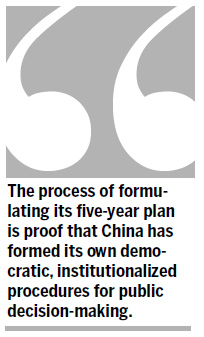
The process of formulating its five-year plan is proof that China has formed its own democratic, institutionalized procedures for public decision-making.
The author is director of the Center for China Studies at Tsinghua University. Source: chinausfocus.com