Hard elements of soft power
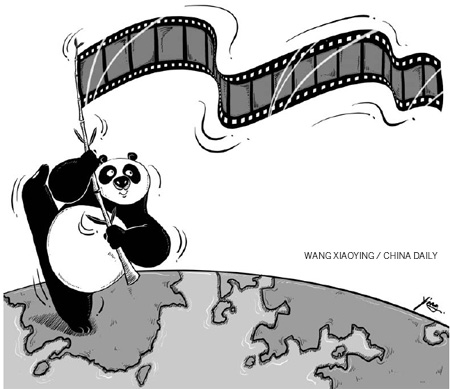
The United States is not just a super power. It is also a soft-power giant. China is honing its soft power skills and building its soft power resources so that it too could be a soft-power giant.
Soft power is a resource for a state, the key ingredient of which is "magnetism". When cultures (such as Chinese culture, in all its richness and variety) or places (such as Beijing, New York and Paris) are magnetic, there will be a strong demand for cultural products made by them.
Chinese culture and Chinese cities have their own magnetism and the world is awash with Sinophiles. But China competes with other "large owners" of magnetic cultures and places such as the US and Europe to get its cultural products a share of the market.
The world is also awash with Francophiles, Anglophiles and a multitude of other "philes", which are less easy on the tongue, including Americanophiles.
Of course, countries do not need to be passive about magnetism. Places and cultures can be magnetized. The Beijing 2008 Olympic Games was a structured and concerted effort in magnetizing a place. And despite the media turbulence in the lead-up to the Olympics, the overall branding exercise was remarkable - and successful in many ways.
Cultural products and places can be marketed and marketed strategically. That is why China, looking at the soft power resource that is Hollywood, wants to examine systematically its production and distribution of films. What are the broad strategic options for China in marketing its cultural products?
On one hand, China can compete in the existing markets using established Western delivery systems to distribute Chinese cultural products tailor-made for Western consumers. On the other, it can use new delivery systems to develop new markets for its cultural products abroad, targeting the Chinese diasporas and seeking a spillover to Western consumers.
The first strategy, by far, would demand less and the second more transaction costs. For practical purposes, China is likely to choose a hybrid strategy, opting not to place all its eggs in one basket.
Cultural products are not merely material things such as books, clothes, films, food and music. Behind them are intangibles, ideas, and/or ways of doing things, which can be uniquely Chinese.
Every Chinese citizen is a Chinese cultural product, a repository of unique Chinese intangibles. And since these intangibles are attractive to the outside world, they are soft power resources. Each and every Chinese traveler, as an ambassador of culture, can radiate China's soft power values during his or her travels overseas.
It is useful to consider the qualitative aspect of soft power of a society. A country can increase the volume of its international messages and therefore expand its soft power quantitatively. But unless the intangible qualitative integrity of its soft power is retained in this expansion, the messages may sound strident rather than soft.
What can we say about the general dimensions of soft power quality with respect to a country, irrespective of whether it's in the East or West? The term "makeup", with three different connotations, deserves serious consideration.
Chinese soft power resonates with Confucian values. The integrity of Chinese culture and Confucian values is the fundamental "makeup" (or construction) of Chinese soft power's intentionality.
A country can enhance its points of magnetism and features of attraction. This is a kind of legitimate use of "makeup" (cosmetics) to accentuate attractiveness, to heighten magnetism.
The third "makeup" (or invention) is something which countries should resist when undertaking soft power exercises, because artificial invention is soon discovered and leads to disbelief.
The three "makeups" enable Hollywood's messages to be contradictory and mean different things to different people. When Hollywood is aggressively pro-American, it disillusions liberals in America and cultural Americanophiles abroad.
But Hollywood's messages are diverse and voluminous and thus allow for appetites for American culture to be constantly titillated. There is another medium that is diverse and voluminous; it includes the flow of tourists, students, businesspeople and migrants across borders.
The three "makeups" can be used as the doctrine of "two dos and one don't" by Chinese citizens traveling overseas in their engagement with foreigners.
The fundamental makeup (or construction) of Chinese soft power must surely arise from the concept of ren yi, which has been translated as humanity, benevolence and love. Ren yi is prescriptive of exemplary behavior.
The best form of public diplomacy is to adhere to one's deepest values. In the Chinese context, this is likely to be the value of ren yi. Chinese citizens at home and abroad can amplify Chinese soft power through the active expression of ren yi in their lives and society.
The author is foundation chair in International Communication at Macquarie University, Sydney, Australia.
(China Daily 11/19/2010 page9)