-
-
-
China Daily E-paper
Highlights
What's Google's game plan?
By Jeff Pan (chinadaily.com.cn)
Updated: 2010-01-15 17:40
 |
Large Medium Small |
Three days ago, Google's Chief Legal Officer posted a blog titled "A new approach to China", threatening to shut down Google.cn and the company's China offices, if its demands were not met. Two reasons were cited for this shocking decision: first, Google was under "a highly sophisticated and targeted attack… from China"; second, Google wants to uphold human rights and freedom of speech.
Wow, I haven't seen such a lofty company for a while, and one can't help but admire Google for choosing the noble ideological values over commercial interests in a hopelessly materialistic world. But a second thought to these two reasons baffled my mind.


My guess to both questions is no. Then what’s the logic behind this reason? Read on the Google post, you will find a strong implication that the attack was an organized crime effort against not only Google, but a number of other large companies. So who was the bad guy behind this shocking conspiracy? Google story did not explicitly offer an answer. The readers were left to figure out the answer themselves, and if you watch Hollywood movies, it’s not hard to find out: the government is behind all these.
Second, the blog post said the company cannot take the Chinese regulations any more, and wants to hold its own ethical ground. But why did Google enter the Chinese market in the first place if it were really an ideological company as it claimed? Integrity entails consistency; I see neither in Google's act.
On the other hand, it is true that the company encountered many obstacles in China in the past year. Most recently, Google was found infringing 80,000 Chinese books, and was forced to apologize. Could this pullout drama just be another way to increase its bargaining chips for more business? Or am I just too mean and narrow-minded, and Google might really just be such a GREAT company?
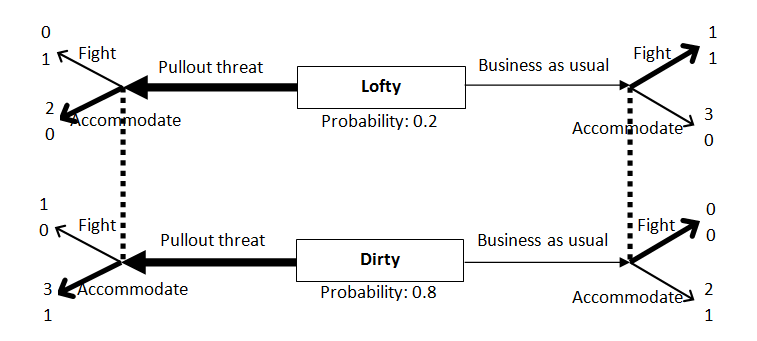
Let me be nerdy and dive into some game theory for a better understanding.
Suppose there is a 20% chance that Google is purely ideology-motivated, and an 80% chance that it's business-oriented, and let's call the two scenarios "Lofty" and "Dirty". Google moves first by choosing between "Pullout threat" and "Business as usual". After Google's decision, the Chinese government then chooses either to "Accommodate" or "Fight". Suppose Google's payoffs depend on its type, it derives an incremental payoff of 1 when it chooses to threat and 0 when it chooses to do nothing, if it is lofty; and an incremental payoff of 0 when it chooses to threat and 1 when it chooses to do nothing, if it is dirty. Additionally, Google derives an incremental payoff of 2, regardless of its type, if the Chinese government chooses to Accommodate. Suppose the Chinese government only wants to fight if Google is dirty. The government gets a payoff of 1 if it fights the dirty type and gives in to the lofty type, and 0 otherwise. Then we have the following chart.