OPINION> Alexis Hooi

|
OPINION> Alexis Hooi
|
|
Unearthing history for all to see
By Alexis Hooi (China Daily)
Updated: 2009-06-18 07:52
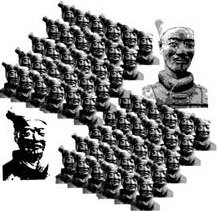
Wow. That is how I felt when I first entered Pit 1 of the Terracotta Warriors in Shaanxi province five years ago. In front of me were the rows of about 6,000 life-sized clay figures fired during the Qin Dynasty (221-206 BC), part of the massive necropolis of China's first emperor and unearthed only three decades ago to capture the imagination of the world.
The weight of Chinese civilization grew heavier with every step I took in the hall as I realized the artifacts were a distant part of who I was. Having a museum director for a father meant much of my childhood was spent among items of antiquity, cultural treasures that allowed me to learn early on the difference in seeing and breathing the past instead of merely hearing or reading of it. That is why the excavation of Qin Shihuang's terracotta army that resumed over the weekend is so crucial. Detractors maintain that the army should be left well alone for future generations because any exposure will degrade the figures and accompanying items, while archaeologists insist preservation technology now includes polyurethane layers that can adequately protect the relics after exposure. For the last two decades, when excavation of the army was stalled for want of appropriate techniques, selected objects from it were exhibited in museums at home and abroad to provide a peek at the archaeological discovery of the 21st century on the outskirts of Shaanxi's provincial capital of Xi'an. A terracotta exhibition at London's British Museum alone drew record numbers by the time it ended last year. Time and again, the crowds that thronged any traveling terracotta exhibition showed that foreigners could just not get enough of the marvel.
The discovery of the terracotta army, listed as a World Heritage Site by UNESCO in December 1987, helped turn Xi'an into a major tourist attraction. Conversely, many visitors to Xi'an will attest to the indifference of the locals to the countless historical remains under a city that used to be the seat of many of China's most important dynasties. Who can blame them for putting history on the backburner and focusing instead on a better life by riding on the relentless development of the country? But that is also where monumental relics like the terracotta army have a role - to remind those living in the present of the human condition, achievements and lessons of the past. The benefits of coming face to face with history make any risk - of damage to the artifacts during excavation - worthwhile. The authorities are already pushing ahead to open more excavation sites for public access, while work at the pits will expand significantly over the next four years. The renewed diggings in the past few days have reportedly yielded colored items such as figurines, horses and bronze arrowheads. There are hopes of finding more figures of high-ranking officials on top of the archers, infantrymen and charioteers already unearthed. Meanwhile, surveys have started on other burial pits and the main mausoleum of the emperor, rumored to hold a lake and rivers of mercury, with ceilings of embedded pearls to form the heavens. The terracotta findings promise to continue wow-ing the world, and I can hardly wait. E-mail: alexishooi@chinadaily.com.cn (China Daily 06/18/2009 page8) |