OPINION> Commentary

|
OPINION> Commentary
|
|
A picture paints a thousand words in Tibet
By Lisa Carducci (China Daily)
Updated: 2009-03-18 07:45 In the 1970s, I used to go from Canada to Italy every other year. My Italian relatives unpleasantly blamed "America" for all the ills of our changing culture. If a couple divorced, it was because they had emigrated to the United States. If a teen rudely answered his father, he was influenced by American movies. In those years, Tibet was known to most Westerners through "Tintin in Tibet". Today, everyone seems to know about Tibet though they have never been there. But they can recite as parrots inanities such as the Chinese government imposed a ban on Tibetan language and culture. If they had been there, they would know that only a minority of Tibetans can speak Chinese or English. Classes are taught in Tibetan, and Chinese is learned as the national language. But there's a dearth of Chinese teachers and several schools can't fulfill this part of their program. Moreover, the Chinese government spent and still spends huge amounts of money researching, collecting, interpreting and publishing Tibetan literature, songs, epics, and religious texts. When I visit Tibetan communities in Sichuan, Qinghai, Gansu, Yunnan, and Tibet as well, I always notice how youths are proud of their culture and stick to it. But it's as normal for Tibetans as it is for Italians, Canadians, Australians, Koreans and Chinese of all ethnic groups to be influenced by "modernity". This is the effect of cultural globalization, and, like it or not, America. Tibetans just like other people have access to TV, Internet, and cell phones. They watch movies, listen to music, read magazines and go to bars and discos. They drink Coca-Cola and beer; they wear jeans and fake Adidas sportswear. All this happens in any developing country, and Westerners don't feel scandalized when seeing Han Chinese wearing western clothes and dying their hair.
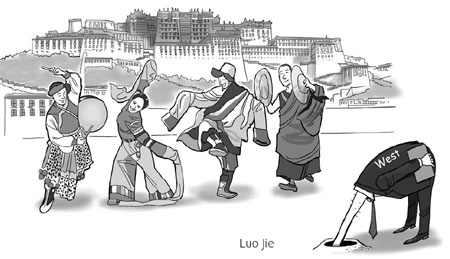 Tibet is just like the rest of the country. Those who believe in a Tibetan genocide imposed by China should go back to school and get some grounding in sociology and global evolution. Last December, I was in a restaurant in Qinghai with three Tibetans. One of them, a monk, asked me why the Western world attacks China about Tibet. I said, "Because they think Tibetans have no religious freedom, and they want to help you by pressuring the Chinese government." After thinking a moment, his cousin said: "Well, we don't have freedom, but this has nothing to do with the government. It's our culture." "What?" I reacted. "You don't have freedom? Do you have to hide when praying? Will you be arrested if you go to temple? Is it forbidden to hang the portrait of the Dalai Lama in your home? (Each family has one, besides the Panchen Lama's.) Aren't you free to turn the prayer mills? A Tibetans' life is so deeply impregnated with religious culture" Their answers to all of my questions were negative. "When a Tibetan is born, he is born Buddhist," came the revelation. "We have no choice of religion." Another story: A Canadian university professor visited Tibet with a local Tibetan guide. The young man told the group that this was his last tour, as he would soon be replaced by a Han. The tourists protested: no human rights, segregation, cultural genocide, etc. But they just didn't know that the Tibetan guide was not qualified and was working illegally, while the Han had taken a training class, passed all the necessary tests (English, history, etc.), and received a certificate. But in the book he published, this professor wrongly interpreted the facts. Considering that the Dalai Lama is known for his charm and charisma, that he has great experience in adapting to different audiences, that what China says and publishes is dismissed as lies, that several western media have never had a representative in Tibet; and that most people who talk about Tibet get their "information" from the web, I suggest that we stop talking until we've seen it with our own eyes. One image is worth a thousand words. (China Daily 03/18/2009 page9) |
