OPINION> Commentary

|
OPINION> Commentary
|
|
US-Russian 'reset' requires real cooperation
By Shen Dingli (China Daily)
Updated: 2009-03-13 07:47 The bilateral history of the two former superpowers turned a new page when Hillary Clinton, the US Secretary of State, and her Russian counterpart, Sergei Lavrov, met for the first time in Geneva last Friday. A wide range of topics were said to be discussed, in particular nuclear weapons and arms control. While most media presented talk between the two sides as a "resetting" of bilateral relationship, I reserve my opinion. To me, the word "reset" is a little bewildering. I propose that the word "readjustment" is more fitting. It better describes how the bilateral relationship is to be adjusted after a period of uncertainty. Why is this readjustment needed then? As we can see, it can mostly be attributed to the arrogance of the US government since the end of the Cold War. Over a long period of time, the US has positioned itself as the sole remaining superpower in the aftermath of the Soviet Union's dissolution, and never took post-Soviet Russia very seriously. What's more, the US and NATO sandwiched the development of Russia into a very limited diplomatic space, and Russia found it very difficult to make its voice heard and extend its impact on the international community. Washington's arrogance reached the climax during George W. Bush's administration. For example, at the end of 2001, Bush notified Russia and announced America's unilateral withdrawal from the 1972 Anti-Ballistic Missile Treaty.
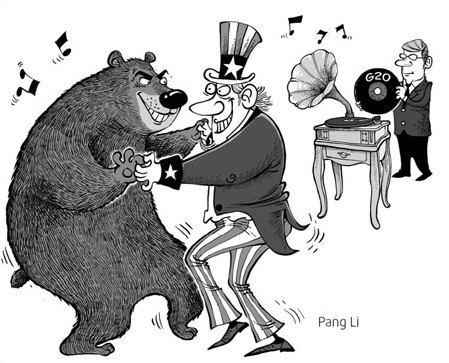 In so doing, the US was not only able to open the way for its own anti-missile defense system; meanwhile, it began to move forward with its missile defense scheme in Eastern Europe as well. More than that, the US government later backed NATO's expansion in Eastern Europe and backed the independence of Kosovo, all of which were considered a big threat for the security of Russia and the enlargement of its international impact. But the era of arrogance is over. Since Barack Obama took the US presidency, the White House has adopted a modest foreign policy and helped ease tensions. As scheduled, Obama's meeting with Russian President Dmitry Medvedev at the upcoming G20 is supposed to be a good opportunity to apply this new strategy. At the London meeting next month, President Obama intends to bring along a series of topics and address some inevitable questions with his Russian counterpart, like the disarmament of nuclear and conventional weapons systems. According to the Strategic Arms Reduction Treaty (START I) signed by the US and Russia in 1991, nuclear warheads should be reduced from 10,000 to 6, 000 at the end of the first phase. Then, another 3000 warheads should be cut under the treaty singed in the second phase. In an ideal proposition, the two countries are expected to possess 1700 to 2200 nuclear weapons each at the end of 2012 based on the Moscow Agreement of 2002. But the US government still keeps 5400 nuclear warheads, while the number for Russia is 14,000. It is very clear that both countries so far have failed to fulfill their commitments. And both are highly unlikely to achieve their 2012 goal. Regardless of when the two powers abandon their nuclear arms, at least, their current caches of devastating weapons already pose big headaches. The warheads they each have far exceed the need to safeguard their nations, and also constitute potential threats to them, even the world. When Barack Obama meets his Russian counterpart next month, he will put forward his new proposal on how to implement the reduction of weapons. The underlying intentions are obvious. They can be more assured when it forces the Democratic People's Republic of Korea and Iran to give up their experiments on nuclear weapons. Moreover, given the fact Russia now possesses more nuclear warheads than the US, the US side could take this opportunity to persuade Russia to cut more so as to achieve a sort of balance. On Russia's side, its current possession of excessive numbers of nuclear weapons is also burdensome. But Russia will not easily approve its old foe's proposal. Russia is looking forward to regaining respect from the US, the position it deserves. If Dmitry Medvedev is satisfied bilateral ties have indeed been reset, he may be happy to restart dialogue with Washington on the nuclear non-proliferation. However, reinstatement of their strategic relations cannot be realized overnight. Before the US gives a plausible explanation on the planned anti-missile shield in the Czech Republic and Poland, Russia will surely be reluctant to resume cooperation. Furthermore, the US should also consider a request from Russia insisting it play a more important role in Iran as well as Eastern Europe. None of these can be settled easily, but all are possible if the two sides really want to cooperate. Regardless of how the two leaders negotiate a new framework for future ties, there is cause for optimism. The author is director of the Center of American Studies at the Shanghai-based Fudan University. (China Daily 03/13/2009 page10) |
