OPINION> Commentary

|
OPINION> Commentary
|
|
Mr Bush wins with gentlemanly goodbye
By Norman J. Ornstein (China Daily)
Updated: 2009-01-21 07:47 The past few weeks have been a time to reflect on the legacy of the Bush administration. It has not been a kind time for George W. Bush. Most analyses have been harsh, raking him over the coals for everything from Hurricane Katrina to Abu Ghraib to the financial meltdown to his advocacy of nearly unfettered executive power. I would join in many of those criticisms. But there is one area where Bush's legacy will be strong and admirable - the way he is leaving office. Presidential transitions are always difficult. The United States has an extraordinarily long three-month interregnum during which the person departing the presidency retains full power while the person elected to assume the office waits to take over. I have likened it to a man who moves in with his fiancee - while her soon-to-be former husband still lives in the house. This awkwardness combines with the natural tension between the old and new over policy and personnel that exists even when the outgoing and incoming presidents are in the same party (ask members of George H.W. Bush and Ronald Reagan's staffs about the 1988 transition). For an outgoing president, there is always some resentment that the new guy is expected to act as president starting the day after the election; everyone anticipates his policies and ignores the actions of the lame duck. The president is often skittish about providing the newcomer with top-secret information, in part because the new team is not formally in place. For the president-elect, the outgoing president's 11th-hour actions, including appointments of his loyalists to career positions, stir resentment.
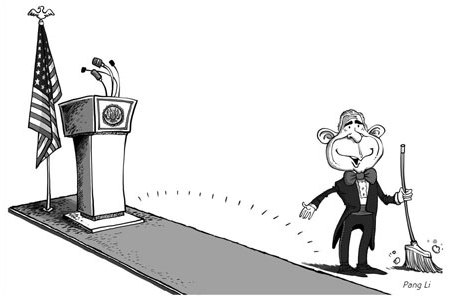 Incoming members of a president-elect's team often encounter sullenness from their outgoing counterparts, or a false eagerness by some who don't want to leave their posts at all. Beginning well before the election, Bush and his chief of staff, Josh Bolten, decided to make this transition different by removing many of the usual obstacles and fostering cooperation and harmony. Bush created a formal transition council, headed by Bolten and including all the people in charge of national security and the economy in his administration, and this group has met regularly to address every action, large and small, that needs to be taken to turn over power. The signals went beyond simple cooperation. Bolten and Clay Johnson, from the Office of Management and Budget, who had worked on the transition when Bush came to the White House, expedited the security checks and other administrative processes for Barack Obama's nominees. National security briefings were held with the president-elect in Chicago, and a high level of important information was shared with his top aides even before they were assigned to specific posts. It is also clear that Bush has agreed to make a few difficult or unpopular decisions on his way out so as not to burden Obama with them - for example, his request last week that Congress release the second half of the $700 financial billion bailout. To be sure, Bush has signed some last-minute executive orders, especially in the environmental area, that will create headaches for Obama. But as a top Obama transition official told me, these were limited in number and scope and all done in the open. A good piece of the credit for the smooth transition is also due to the Obama transition team. But it was important for Bush to be accommodating, given the nature of this transition, occurring as it does during a time of war and economic crisis. The nation can little afford a rocky transfer of power. The US also faces threats from terrorists and other adversaries, and the first few months of a new administration can be a vulnerable time for the nation - when the full national security and economic teams are not yet in place and no crisis decision-making process has been established. The Bush administration may be leaving the country with big policy problems. But Bush deserves a big gold star for the way he is leaving his office. The author is a resident scholar at the American Enterprise Institute The New York Times Syndicate (China Daily 01/21/2009 page9) |
