OPINION> Commentary

|
OPINION> Commentary
|
|
Failed WTO talks equal more imbalance of trade
By Raj Patel (China Daily)
Updated: 2008-08-05 07:22 When the World Trade Organization talks collapsed in Seattle in 1999, there were parties in the streets and a wailing in the corridors of power. The failure of the Doha Round of WTO talks in Geneva last week has drawn a more muted reaction from both its champions and critics. In Seattle, it was possible to tell a story in which the voices of people on the streets mattered, in which the disenfranchised had scored a victory against an unaccountable agent for international capital. This failure had less to do with global justice, and more to do with the growing pains of international capitalism. To the untrained eye, it's hard to tell that anything's different. Today's ducks of international capital still look, walk and quack the same. The financial markets didn't seem to care, with major indexes untroubled. In part, this is because the contribution that the Doha Round would have made to a global economy of $54 trillion, by the WTO's own generous figures, is a mere $50 billion. Yet some countries clearly lament the collapse. In a press conference last Wednesday, Burkina Faso's trade minister, Mamadou Sanou, said, "We can hardly control our anger." And he's right to be annoyed. As a cotton-exporting country, his farmers are being wiped out by the multimillion-dollar support that the US gives its cotton exporters, but which Burkina Faso is prohibited, under WTO rules, from doing anything about. "They wanted me to be here to negotiate on cotton. I have been here for 10 days and I haven't been able to discuss cotton," Sanou said. For its part, the US was particularly keen to blame India and China for failing to enter into the spirit of the negotiations. Beneath the sighed pronouncements of Susan Schwab, the US trade representative, was a thinly veiled lament of "when will they learn?" 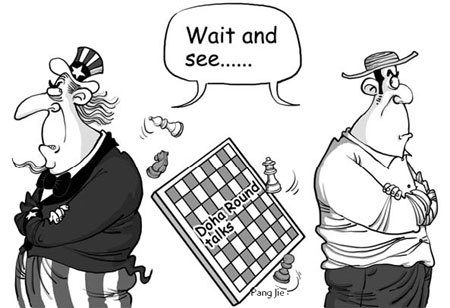 To be clear, the historical spirit of the WTO has been for developing countries to shut up and do what they're told and, if they're very good or very big, they'll get a scrap or two from the EU and US's table. On that table was a tentative agreement between the main negotiating parties, reached in the dark of July 25 night. The EU and the US had given some ground to demands that skilled workers from Asia be allowed entry to the EU and US markets. More visas were promised, and it looked as if the deal might be sealed. Over the weekend, though, India squirmed. Winning visas for the IT industry would keep the middle classes happy, but the majority of Indians depend on agriculture. While politicians are often happy to genuflect before a rural Mother India and then bankroll her urban sons, with an election looming they needed to do more. The government has already promised to cancel a slice of farmers' debt in a spectacular and utterly cosmetic pre-election stunt. But this isn't enough. And a sell-out at the WTO wouldn't play well in the fields at home. So the Indian delegation insisted that there be some protections for their farmers from the surge of imports that inevitably follow tariff cuts. The US and the EU proposed a threshold for support that was too high to be meaningful. India, backed by a range of other countries, held its ground. So the talks collapsed. This doesn't flag an end to US and EU hegemony. It merely confirms the arrival of more big players and the re-configuration of that hegemony. India, China and Brazil can no longer be taken for granted, and the EU and the US will need to negotiate accordingly. But it would be foolish to think that, as poorer cousins, the ascending powers might become a voice for the disenfranchised. The most successful beggars in the international trade club have graduated - Oliver has become Fagin. After the elections, business will return to normal. Trade talks are diplomacy's most rugged zombies, able to rise despite a thousand deaths. We can expect to be reading about the tentative resumption of talks next year. In the meantime, of course, farmers in developing countries will still be exposed to the inequities of the current system. Those inequities haven't worsened, but the failure of the talks are a small whoop. When the poor are so comprehensively pinioned by international economics, it's a slim victory that the screw hasn't turned further. The author is the author of Stuffed And Starved The Guardian (China Daily 08/05/2008 page9) |
