
India takes new look at Africa
Updated: 2008-04-16 07:27

The end of the Cold War witnessed India's traditional reason for engaging Africa eroding completely.
That was because by the early 1990s, with the independence of Namibia and the transfer of power in South Africa, India's traditional stance of emotional and political solidarity with Africans against colonialism and racialism had outlived its relevance.
India had also lost its long-standing ally - the Soviet Union - and refashioning its foreign policy was to take a long time.
It is in this backdrop that one needs to examine the tone and tenor of the recently concluded inaugural India-Africa Forum Summit in New Delhi.
The two documents adopted at this Summit - Africa-India Framework for Cooperation and Delhi Declaration - cover rather broad issues like reorganization of global institutions, climate change and terrorism but underline the two sides' intention to deepen and broaden their mutual economic and security partnership.
Some of this has already been visible in India's recent initiatives involving bilateral economic and defense agreements.
The summit was successful in highlighting how both India and Africa remained unrepresented in most post-World War II global institutions.
Similarly in climate change, it put the onus on the developed world to honor its commitments and to facilitate technology transfers to enable developing countries to comply with global norms and to develop their joint fight against international terrorism.
For the present, the two sides identified food and energy security as their major concerns.
And here, while India promised to provide Africans with necessary seeds, skills and technologies for better farm productivity to achieve self-reliance in food production, resource-rich Africa held great promise for India's energy and other requirements for rapid economic development.
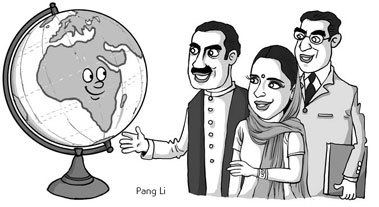
More substantially, this summit was also used to outline India's claims that it would invest $500 million in sectors like IT, railways, telecoms, power and infrastructure in Africa and will double its trade with Africa in the next five years.
Similarly, India will double financial credit to Africa to $5.4 billion in the next five years. Inaugurating the summit, Indian Prime Minister Manmohan Singh announced that New Delhi will provide preferential access for exports from 50 least developed countries, of which 34 are in Africa.
India's NIIT, Asia's leading IT trainer, had begun working in Africa from its first center in Botswana in 1997. It has since opened 36 centers in eight African countries and trained more than 150,000 people. In addition to its $1.5 billion iron ore plant in Cote D'Ivoire, the Tata group, also India's largest automobile manufacturer, seems all set to build manufacturing facilities in South Africa and develop a major presence in selling its vehicles in several other African nations.
India has also been training and supplying African defense forces. About 800 officers from 12 African countries have been trained under the India Technical and Economic Cooperation Program. India also supplied patrol boats to Mauritius and Guinea Bissau in 1993 and light helicopters to Namibia in 1994.
Experts believe India can keep close historical and cultural ties with Africa by providing continued support against colonialism and institutionalized racialism and by providing low-cost services and technologies in sectors like IT, biotechnology, pharmaceuticals, and diamond cutting/polishing. The Indian diaspora in Africa could be an important factor in such cooperation.
The Indian prime minister clarified this during his concluding press conference by saying: "We are not in any race or competition with any other country It is up to Africa to determine the path they wish to pursue."
Other than India's growing activism in engaging the Indian diaspora, trade and investments, it also talks about India's first ever listening post on foreign soil in northern Madagascar - that began operations in July 2007. Starting from Prime Minister Narasimha Rao's visits to Ghana and Burkina Faso during November 1995 till very recent visits to Angola and Namibia by India's very dynamic junior minister for Commerce, Jairam Ramesh, these few and far between visits of India's leaders have already woven a web of bilateral relations. These are now being upgraded to a multilateral format.
The pace of India's engagement with Africa has clearly picked up momentum. And here, the African Union becoming the nodal convener of these India-Africa summits promises to facilitate coordination in implementing their action plans for mutual cooperation. As of now, the two sides have agreed to hold similar summits every three years.
The author is associate professor with the School of International Studies, Jawaharlal Nehru University, New Delhi
(China Daily 04/16/2008 page9)
|
||

|
|
|
|