
No need to tamper with HK currency
Updated: 2008-04-15 07:39

Whenever the Hong Kong dollar peg is seen to be under pressure because of an unusually large movement of the US dollar either way, there is no shortage of economists and commentators calling for the scrapping of the 24-year-old currency arrangement.
This time, it is the depreciation of the US dollar, which has depressed the exchange rate of the Hong Kong dollar against most other major world currencies and the renminbi, although the Hong Kong economy has remained robust. This has led some economists and investment analysts to conclude that the currency peg has driven up import prices, which, in turn, is fuelling inflation.
Their call for currency de-pegging was rebuffed by Hong Kong monetary chief Joseph Yam. Citing a study by the Hong Kong Monetary Authority (HKMA), the de facto central bank of which he is chief executive, Yam noted that a 10 percent depreciation of the US dollar against other currencies would cause Hong Kong prices to rise no more than 0.82 percent in the short-term, and 1.61 percent in the medium-term. Yam attributed Hong Kong's rising inflation rate mainly to wage increase at a time when strong economic growth is pushing up the demand for workers.
Some commentators hold the view that inflation is not necessarily bad for Hong Kong. I am not sure if I understand their logic because under the linked currency regime, the economic adjustment mechanism works through the price of goods and services, or the value of assets rather than the exchange rate. For that reason, inflation, or deflation, for that matter, cannot be seen as good or bad because they are all part of the adjustment process before the economy can regain equilibrium.
The Hong Kong free-market economy is open to outside influences that are beyond its control. In the past, the automatic adjustment mechanism worked largely through the exchange rate regime. In a typical up-cycle, the surge in exports would invariably push up the value of the Hong Kong dollar, which would hamper competitiveness, leading to a downturn in overseas shipments and the subsequent weakening of the currency.
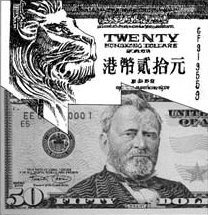
Since the link exchange rate system was introduced, the economic cycles have been marked by the swings in domestic prices. The meltdown of asset values after the outbreak of the Asian financial crisis in 1997 was a case in point. The deflationary pressure was so immense at one time that the rationale of maintaining the currency peg was brought into serious question.
The issue seems to have resurfaced now under a completely different set of economic circumstances. Reflecting brisk economic growth, both the stock market and the property market have recovered smartly since 2004. Increased investments and other economic activities have created a strong demand for workers at almost all levels, resulting in a fall in the unemployment rate to a 10-year low.
Such developments have apparently set the economic adjustment mechanism in motion, as reflected in rising domestic prices. The process, however, has obviously been distorted by the depreciation of the US dollar which has dragged down the value of the Hong Kong dollar against other major world currencies.
So far, the scale of distortion has remained small, according to the HKMA survey. At most, the currency peg will prolong the adjustment process. It is unlikely to add too much pressure on inflation because Hong Kong has a hugely diversified source of import. There is little reason at this point in time to question the wisdom of maintaining the currency peg.
E-mail: jamesleung@chinadaily.com.cn
(China Daily 04/15/2008 page8)
|
||

|
|
|
|