Thieves of the State's coal fields
Updated: 2008-01-16 07:40
During the trial of suspects believed to be responsible for a mine blast that killed 105 people on December 5 last year in Hongtong county, Shanxi province, one suspect revealed that the main investor of the coal mine had received more than 100 million yuan ($13.3 million) in profit from the mine in less than three years.

For average salary earners whose incomes do not exceed 100,000 yuan ($13,300) a year, this figure is simply shocking. They could well doubt if the huge profit was a reasonable return for the mine owner's investment.
Today, prices of mineral products keep increasing throughout the world as a result of shortages. The value of a mineral product consists of two components: the value of the mineral resource itself and the cost of prospecting and mining it. The rise in the prices of mineral products actually reflects the increase in the value of the resources. The profits thus generated, however, have gone to mine owners rather than the State, the real owner of the resources and the investor in prospecting the mines. This is obviously unreasonable.
Though I am not an economist, common sense tells me that one has to pay the State for the right to excavate coal to sell it for profit. Do coal mine owners pay? How much do they pay? With the questions in mind, I searched online for an answer. The search enriched me with knowledge about State policies on mining but filled me with more questions as well.
I learned that a coal company needs to pay the resource tax and resource compensation fee to obtain the right to mine the coal. The former is about 1 percent of the current coal price, calculated on the basis of the volume of actually excavated coal; the latter is levied on the basis of the gross profit of sales at the rate of 1.18 percent. By contrast, the same rates in Western developed countries are something between 8 percent and 10 percent.
Such taxes are obviously too low. And even these low taxes are often evaded by coal mine owners in collaboration with some local officials, as has been widely reported in the country's coal mining regions. Natural resources belong to the whole nation but are now taken by a small part of the population nearly free of charge. What have the authorities done to address this problem?
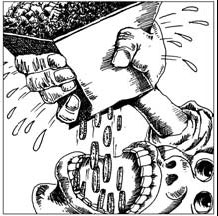
As the taxes and fees they pay are calculated according to output and sales rather than the prospected and proved reserve, coal miners naturally mine those parts of the reserve that are easy to excavate and ignore those that they find difficult to mine. This undoubtedly leads to the huge waste of coal and irrecoverable damage to the reserve. In most of China's widespread small coal mines, the excavation rate is 15 percent, while the reasonable rate, as required by the government, is no less than 75 percent.
What is more, illegal mining is rampant in many places. According to China News Weekly published on Monday, unauthorized mining "can be seen everywhere" in Ningwu, a major coal-producing county in Shanxi, and "it is easy to earn 200,000 yuan a night" by mining in illegally excavated pits.
These thieves of State property are not only covered by the darkness of the night deep in the coal tunnels, but by some government officials as well. The China Youth Daily reported yesterday that a former mayor of Heshun county, Shanxi province, was sentenced to 20 years in jail for taking 3 million yuan in bribes, of which 2 million yuan was given by coal mine owners.
E-mail: liushinan@chinadaily.com.cn
(China Daily 01/16/2008 page8)
|
|
|
||

|
|
|
|