To look or not to look is the question
Updated: 2007-12-22 08:01
What is the biggest cultural barrier for a Chinese to overcome when dealing with people from other countries?

For me personally, it is none other than looking into the eye of the other party.
I knew early on while I was still in school that Western people value eye contact. But it is one thing to know something; it is another to be able to practice it.
It took me a good three years living in the United States to completely get over my "handicap". For a while, I invented a fence-sitting strategy whereby I would almost look at the person I was conversing with, but with a slight angle so that our eyes wouldn't be locked together at all times. I would appear to be looking without really looking.
Now you may ask: What's the big fuss about looking someone in the eye while talking to him? Isn't it the most natural thing to do?
Well, let me tell you: No, not for someone brought up and taught NOT to look that way. Actually, I've never encountered a specific instruction in our textbooks that we should not look directly at someone else while talking. And in school, we also look at the teacher. But when it's a one-on-one conversation, it is simply impolite to gaze, especially at someone of a senior generation or ranking.
This little habit of ours has probably created more misunderstanding than most cultural quirks. In Western culture, it is impolite to look at something other than the eyes of the one you talk to. Besides, you may be interpreted as lacking self-confidence or even lying.
Just imagine how many perfectly competent job candidates fell through this crack when recruiters from multinational companies took their Chinese way of politeness to mean the typical negative things associated with "not looking them in the eye".
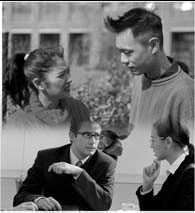
Now, you may say that since we have rational knowledge of this behavioral discrepancy, why can't we adopt the Western way while talking to Westerners? Shouldn't that be easier than speaking a foreign language?
Easier said than done. Because "not looking" is so rooted in our cultural genes, during my transformative years, I constantly went through a process of internal struggle of "looking or not looking". I knew I should look, but just couldn't bring myself to it.
To understand how hard it is, you may have a little role-reversal and for once pretend you're a typical Chinese and look at the translator while talking to your host. If you feel comfortable, you can probably be a good actor.
Now let's take a step back. Suppose you cannot do that with ease just as you cannot take on a new accent at your will. You should pause for a moment when you see your Chinese friends engaging in the "wandering eye" and say to yourself: Hey, this guy may be a little shy, but he is not being discourteous because he grew up in a culture of discouraging such stares.
As for my personal experience, switching between looking and not looking is much harder than switching between two languages. After I came back to China as a "sea turtle", I could refrain from sprinkling my speech with English words, but I simply couldn't go back to looking sideways again.
Later, a friend scolded me for being "thoroughly Americanized" because my intent look was "too aggressive" and made him "nervous". I wish I could return to my "looking yet not looking" mode again, but no amount of theorizing can help me adjust with each occasion.
Habits die hard - good habits or bad. They make us who we are. Maybe we should all install a little mental translating device to remind ourselves of our little differences.
E-mail: raymondzhou@chinadaily.com.cn
(China Daily 12/22/2007 page4)
|
|
|
||

|
|
|
|