Saying goodbye to the shivers
Updated: 2007-11-08 07:12

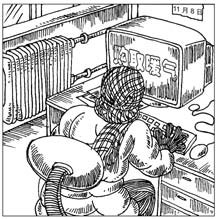
Winter arrived in North China earlier this year than in previous years. As a result, many Beijingers - myself included - are shivering in their offices and homes.
I should feel lucky because I have an office with a window. However, the office building was built in the late 1980s. I doubt the walls were built with insulating exterior partitions. When strong north winds blow in winter, I often feel the cold seeping through the wall.
This year is worse, as the construction workers who are giving a total facelift to our building have removed the outside layer of the window.
Like many Beijingers, I am eagerly awaiting November 15, the day designated more than half a century ago for the start of central heating, a remnant of the planned economy and a reminder of the times of scarcity.
Life has dramatically improved since then. The popular desire to be able to operate one's own central heating in response to the natural rise and fall of thermometers rather than some preordained date seems to be justified.
When to turn on the central heating and how to manage it has remained a thorny issue, even as major hotels, leading government offices and privileged residential areas are already heated up.
Beyond such perennial problems as funding shortages, energy conservation and environmental protection are now key concerns, especially with the rise in oil prices and the seriousness of winter smog in Beijing.
Beijing is not alone. According to media reports, 99 percent of the nearly 40 billion sq m of construction in China consumes more energy than the average in developed countries. In fact, buildings alone guzzle 27 percent of the country's energy.
I believe old office buildings like the one I work in waste a lot of energy because they are not very well insulated. I also have doubts about some of the new buildings with fashionable glass walls, which are half as energy efficient as insulated cement walls.
Even though we are bragging about new green construction for the 2008 Beijing Olympic Games, it is really time both the government and the public take a close look at the buildings that are being built. A few years ago government construction watchdogs ordered that all faucets adopt water-saving improvements. The same conservation-minded measures should be adopted for walls, roofs, windows and other fixtures.
Governments, institutions and businesses should spare no expense in upgrading old office and apartment buildings to improve windows with effective insulation.
Such improvements should be adopted across the country. Experiments are underway, such as the pilot renovation project on the residential Apartment Building No 12 on Huixin Xijie Street, which is being carried out with guidance from both Chinese and German specialists.
From my window I can see Building No 12, to which construction workers have applied a whitish material said to use a German insulation technology that will maintain indoor temperatures. The building's central heating, hot water and electricity conservation systems are also all due for an overhaul.
It is encouraging that the city has plans to upgrade some 4 million sq m of housing with similar conservation technologies over the next few years.
As Jin Liqun, vice-president of Asia Development Bank, told me on Tuesday, improving energy efficiency in existing buildings will make a major contribution to the reduction of CO2 emissions.
It is hoped that fewer people will shiver indoors even as we use less fossil fuels to heat our offices and homes.
E-mail: lixing@chinadaily.com.cn
(China Daily 11/08/2007 page10)
|
|
|
||

|
|
|
|