Our fashion designers need support
Updated: 2007-09-06 06:30
A well-known designer in Shanghai last Saturday showed off her new creation, Chinese men's wear for formal occasions.
This is formal attire with a multi-ethnic Chinese legacy, Wen Hong, the designer, said.

As soon as the press conference was over, such headlines as "Formal Chinese men's suits emerge" and "Shanghai garment sector promotes 'Chinese suits' to compete with Western suits" appeared on the Internet.
Yesterday morning, we were told that some celebrities, such as history professor Yi Zhongtian, television host Cui Yongyuan and Peking opera star Shang Changrong, had placed orders for the tailor-made Chinese suits.
But there were other voices, with the loudest doubting whether the new Chinese suits could really "beat" Western suits, since the suits were created out of set concepts while still borrowing elements from Western attire.
Although everyone is entitled to his/her opinion, I believe the media should be tolerant and open-minded about new fashions in general. That is to say, the media should not make hasty conclusions about this style of clothing or other new creations, even for the sake of argument.
I have read carefully Wen's explanation of the new suit. It is elaborate and filled with so many modifiers and ideals that it could confuse laymen unfamiliar with her history as well as a tailor's terminology. People could even argue some of the concepts were a bit far-fetched. For instance, the front inside lining pattern is said to resemble the Chinese character zhong, which not only means center, but also honesty or fairness.
However, I can sense the eagerness and aspiration of Wen and her colleagues.
"I believe it is imperative to come up with such recognized and proper suits for us Chinese to go with the rise of China," said Wen, who established her fame years ago for her tangzhuang.
I still remember the long queue of theater-goers one September evening 1998, as they were checking into the Taimiao, once the ancestral temple of the Ming (1368-1644) and Qing (1644-1911) dynasties in the southeast corner of the Forbidden City.
It was the opening night of Turandot in the Forbidden City, conducted by Maestro Zubin Mehta and directed by Zhang Yimou.
The most striking of all the attire worn was the dark silky tangzhuang with auspicious patterns. But it still took some years before the tangzhuang became a sensation, when APEC leaders wore it in various colors.
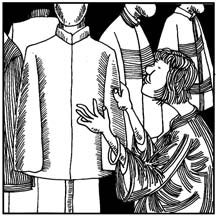
Historians say the tangzhuang had borrowed more elements from the Manchurian dress code in the Qing Dynasty than the more ancient Tang Dynasty (AD 618-907). But despite the arguments, the tangzhuang is regarded as the traditional Chinese outfit today, best for festive occasions.
It is only natural that Wen and her colleagues should now come up with more formal attire to enrich the contemporary Chinese wardrobe with designs for more formal events.
I have attended and seen formal occasions in Japan, India, Thailand, Vietnam and many other Asian countries. All have their own formal attire. Why should not we Chinese have our own?
Wen and her colleagues are not alone in the search for a distinctive expression of Chineseness in clothing.
Some Chinese have dug further and have been promoting hanfu, the robes of our ancestors living in the Han Dynasty (221 BC-AD 220). These young women and men say the robes are most suitable for ceremonial occasions.
All these endeavors are worthy of our congratulations, instead of doubts and discouragement.
E-mail: lixing@chinadaily.com.cn
(China Daily 09/06/2007 page9)
|
|
|
||

|
|
|
|