Bottled water is not so eco-friendly
By Li Xing (China Daily)Updated: 2007-07-05 06:55
 While shopping at a supermarket near home, I was surprised
to find bottled water from as far away as Southwest China's Tibet Autonomous
Region.
While shopping at a supermarket near home, I was surprised
to find bottled water from as far away as Southwest China's Tibet Autonomous
Region.
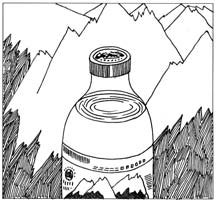
The price is four times more expensive than the other domestic brands, as it projects the image of coming from a glacial spring on the roof of the world.
The source dates back to ancient times, and, according to some reports on the Internet, and it contains "trace elements and minerals good for people's health".
I don't doubt the profits the brand of precious glacier spring water generates for business managers and the jobs its production, transportation and distribution create.
Bottled water is one of the world's fastest-growing commercial beverages. The
United States remains the largest consumer of bottled water, with some of the
prized brands, such as Fiji Water, coming from distant corners of the world.
While Charles Fishman claims in his article in the July issue of Fast Company that "bottled water is often simply an indulgence, and ... it is not a benign indulgence," many Chinese may not agree.
Among the more pragmatic Chinese who love drinking hot tea, bottled water is either a convenience or a necessity. Often, they have no choice but to turn to bottled water, as sources of tap water become contaminated. After all, water is in short supply in some 110 urban centers in China.
It is not surprising that the consumption of bottled water more than doubled between 2000 and 2005. Major bottled water companies now employ hundreds of thousands of technicians, workers and salespeople. One company claims that each of its three state-of-the-art assembly lines churns out 800 bottles every minute.
However, as China upgrades its standards on drinking water and steps up efforts to clean up rivers and lakes, it should also set stricter rules to stop excessive growth in the bottled water business.
After all the manufacture and shipping of bottled water adversely impact the environment and the ecology.
According to Worldwatch Institute, undue extraction of natural mineral or spring water to produce bottled water threatens local streams and groundwater. Plastic bottles, most of them not recycled, create unnatural waste.
At the same time, the production and shipping of bottled water consume a lot of fossil fuel. The cost of producing bottled water is some 10,000 times more than tap water, higher than drilling for fossil fuels, according to some experts.
With this in mind, the government at various levels should invest more money in ensuring that tap water is safe and available to all residents, whether they live in urban centers or rural areas.
Meanwhile, individuals should follow the lead of Liao Xiaoyi, founder of the Global Village of Beijing, and other environmental activists, to refrain from drinking bottled water. This is in addition to other simple things that they encourage people to do to reduce our footprints on earth, such as driving less, recycling more, using less hot water and avoiding products with a lot of packaging.
As for the glacial spring water from the roof of the world, I believe it is better to leave it alone and preserve it as a way to help stop global warming.
After all, if we continue to slide toward what former US Vice-President Al Gore calls the "tipping points", we will have to cope with unbearable heat as glaciers further retreat and disappear. The source for the precious spring water will be gone before we know it.
E-mail: lixing@chinadaily.com.cn
(China Daily 07/05/2007 page10)
|
|
|
||

|
|