Raymond Zhou
Posthumous fame attracts followers
By Raymond Zhou (China Daily)
Updated: 2007-04-14 06:50
 |
Large Medium Small |
This week marks the 10th anniversary of the death of Wang Xiaobo.
As in a Mark Twain tale, Wang's death occurred at exactly the point when his writing career was poised for liftoff. It is ironic that in his lifetime he had difficulty getting his books published, while, since his death, copies have been flying off the shelves. Even collections of his unfinished manuscripts and private letters are snatched up by avid readers.
 Wang Xiaobo (1952-97) was no ordinary writer. He worked outside the system and thought out of the box, so to speak. He was a champion of free thought in a culture where sticking to dogma is not only the norm but a life-preserving necessity.
Unlike his contemporaries who wrote as a profession, Wang Xiaobo did not graduate from a school of humanities or liberal arts, did not belong to any writers' association and, in the last five years of his life, was not employed. He was an outsider and did not have a coterie of literary peers. He once said: "I know there's a clique somewhere, but I don't know where it is."
He majored in mathematics at school and taught accounting for a while. He was never taken seriously by those inside the system, and they still cannot bring themselves to face the fact that great writers can exist out of their circles. But a few of them were able to admit that Wang was in a league of his own.
Wang's writing can be clearly divided into two categories: essays and fiction. The novels The Time Trilogy - The Golden Age, The Silver Age and The Bronze Age - caused a sensation when published shortly after his death. Mostly based on his life experiences and philosophies but often using ancient settings, the stories depicted his inner worlds, including his sexual fantasies. He cited Marguerite Duras as his main source of inspiration.
Most people know him as an essayist, though. Wang was heavily influenced by Bertrand Russell, advocating rational and scientific thinking and battling against mind imprisonment. He imbued his articles with such wisdom. But what makes his writing click with a generation of Chinese readers was his touch of Mark Twain-style humor and satire.
In one of his essays, he wrote about a pig that refused to join the herd. It has since come to symbolize independence and non-conformity - an icon of what Wang Xiaobo stood for.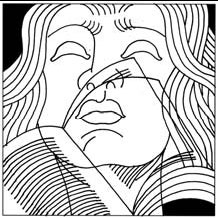
After his death, Wang was elevated to a status very few Chinese writers have ever achieved. He has become an intellectual that is popular with a wide swath of the population not for any publicity stunts but for his mind-liberating thoughts.
But on his way to superstardom, something funny happened something of a reminder of what Mozart went through shortly after his death. Legions of his fans not only hailed his writing, but started to idolize him. According to his widow, Li Yinhe, the famous sexologist, there are people who use "Wang Xiaobo" as a code.
When you browse the Internet and read how people talk about him, you'll get a sense that Wang Xiaobo was not just this brilliant thinker and writer who opened a new vista for the mind's eye, but an omnipotent god. He is now also portrayed as a romantic lover. And people trek to his workplace in Yunnan Province, where he toiled as a "youth sent down for re-education", to get a taste of his greatness.
In a sense, Wang Xiaobo as an icon has more to do with selling books than campaigning for his ideas. Yes, he was a worthy successor to Lu Xun, but mind you, Lu Xun the symbol was detached from Lu Xun the man and the writer and used, to a great extent, for political purposes. A true admirer of Wang Xiaobo should have an independent mind, more than anything else.
Email: raymondzhou@chinadaily.com.cn
(China Daily 04/14/2007 page4)
| 分享按鈕 |