Li Xing
Freedom to blog is not license to slander
By Li Xing (China Daily)
Updated: 2007-04-12 07:11
 |
Large Medium Small |
Tim O'Reilly, whom the Chinese media call the "Internet heavyweight", issued a proposed code of conduct on Sunday that asks bloggers to be responsible for what they post on their blogs and refrain from attacking others.
Suggesting that people should avoid posting anonymous comments, the code was proposed after a well-known American blogger, Kathy Sierra, found death threats posted on her blog last week, according to The New York Times.
 O'Reilly's proposal, which www.sina.com.cn has translated into Chinese and posted in its science section, has drawn netizens' comments.
Some fear that the code would infringe on their freedom of expression and their choice of whether or not to remain anonymous. Most support the idea of making the web a civil place, not a battleground for harassment and slander.
The debate will surely go on, but I believe such a code is necessary in China, especially to avoid the spread of verbal violence on the Internet.
We Chinese should be familiar with what havoc verbal violence can wreck on society.
When my friend recalled the early days of the "cultural revolution" (1966-76) he asked me how I'd feel when I, as a teenager, went through my home alley whose walls were plastered with posters screaming out slanderous words against my father.
And when most of my neighbors shied away from me and pointed at me behind my back, linking me with the condemned on the posters.
In those days, many people became targets for slander in their public work as well as private life in the name of "rooting out capitalist roaders", "anti-revolutionaries", "traitors" or "Western spies".
Those accusations naturally aroused anger, frustration, despair, guilt, or all of these emotions.
When we came out of those chaotic years, the posters were made unconstitutional and many of us vowed never to pick up the practice again.
However, the malignancy of the posters was so strong that its poisonous effect is still being felt today in the age of the Internet.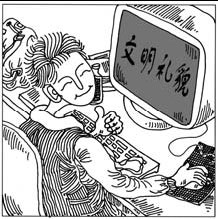
In anonymity, bloggers and passers-by of BBS (Bulletin Board System) sometimes gather to lash out at some popular film or music stars, using all the derogatory labels they can think of.
Film star Zhang Ziyi recently has fallen victim to such attacks after the media revealed that she posed nearly nude for an advertisement in Japan.
At other times, some netizens join hands battering people who commit a wrong - such as a young woman who killed a stray cat in the street. They use the violent lingo that was heard and read during the "cultural revolution" years.
Some people may argue that a code of conduct not only deprives netizens of their freedom of expression but also discourages criticism, which society needs for healthy development.
Indeed, criticism is like doses of bitter medicine to help treat the ills and wrongs in society or offer advice for better creative arts and other works.
But viciousness, slander, and disrespect for people's individual choices and private lives are not criticism. They are poisons that harm the freedom of individuals and social harmony, whether they appear on the Internet or in society.
E-mail: lixing@chinadaily.com.cn
(China Daily 04/12/2007 page10)
| 分享按鈕 |