Cold truth about our city heating
By Li Xing (China Daily)Updated: 2007-03-22 07:08
I remember crying my heart out one day when I was six, seeing my father off at the Beijing International Airport. He was going to Jakarta, Indonesia, to work at the Chinese embassy, leaving my mother and me behind in Beijing.
My mother was not there to consol me; she was lying in bed at home, recuperating from carbon monoxide poisoning. At that time, there was no central heating in our apartment building and each home had a coal stove. Carbon monoxide poisoning occurred when the stovepipe leaked and the room lacked ventilation.
 I escaped because I'd been in a boarding kindergarten.
Because of the incident, we were even happier than our neighbors when our
building was connected to the central heating network in Beijing the next year,
in the middle of 1960s.
I escaped because I'd been in a boarding kindergarten.
Because of the incident, we were even happier than our neighbors when our
building was connected to the central heating network in Beijing the next year,
in the middle of 1960s.
When I began middle school in the early 1970s, I was surprised to find that the homes of my classmates still used coal stoves for heating even though they lived in apartments no more than 20 meters behind mine.
In those days, we attributed the lack of many comforts in our lives to the country's economic backwardness.
As the economy boomed and lives got better, the central heating network in Beijing expanded in urban centers with a grid extending some 680 kilometers. The grid now warms up office and apartment buildings totaling some 102 million square meters of floor space, roughly equivalent to 593 times the entire space of the Great Hall of the People.
However, the central heating routinely ends on March 15 for the majority of residential and office buildings even when temperatures outside drop below zero at night as a result of a cold front. Only a privileged few residential and office buildings continue to enjoy heating well into late April.
Even with more layers of clothing needed as I write this column, I shouldn't complain. Hundreds of millions of people, who live by, or south of, the Yangtze River, have no chance to enjoy central heating at all in winter, when the average temperatures are well below 10 C.
Even in Beijing, many urbanites, farmers and migrant workers in low-rise houses still have to rely on coal stoves. Part of the cost of coal heating, the Beijing Emergency Medical Center treated some 839 people suffering from carbon monoxide poisoning between last November 15 and January 29.
Central heating is a State benefit that only some urban people in areas north
of the Yangtze River enjoy. 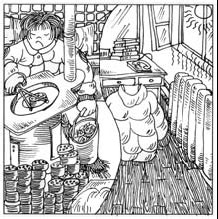
A remnant of the planned economy, the current heating system is plagued with problems. The service providers complain of difficulties in collecting fees while residents grumble as the mercury in their living rooms and bedrooms hovers below 16 C, the minimum standard for sufficient heating.
Rising demand for better services and increasing demand for better and larger housing creates a strain on limited fossil fuels.
However, many residents and office workers inover-heated buildings brag about how they are dressed only in shirts or even T-shirts indoors with windows wide open. Heat is still on in school buildings during the winter vacation and in all office buildings during the week-long Spring Festival.
The Ministry of Construction announced two years ago that central heating as a State benefit must be revamped and people must realize that they must pay for the heating services themselves.
Whatever experiments are made in some small cities, no measure seems to address the problems of overheating, or heating on demand. It will take years before most of us can even dream of enjoying central heating along the Yangtze River or on colder days after March 15.
E-mail: lixing@chinadaily.com.cn
(China Daily 03/22/2007 page10)
|
||

|
|
|
|