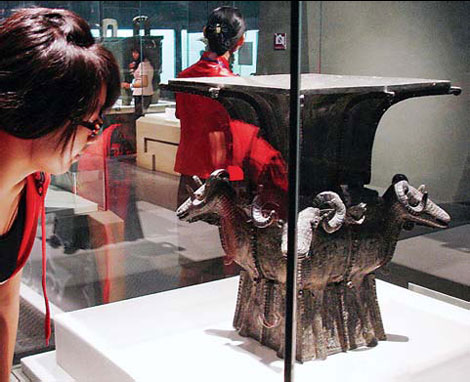
A visitor scrutinizes the Four Ram Zu, a bronze vessel of the late Shang Dynasty. Below is the historic Simuwu Ding vessel.
"A historian who worked in the National Museum for decades once told me that he had never seen the real Simuwu Ding vessel, even though it was the most precious exhibit in the museum," says Liu Xu, a museum tour guide, about the ongoing cultural relics exhibition at the National Science and Technology Museum of China.
Thanks to the Olympic Games, the Simuwu Ding, together with other 271 items from 77 museums around the county, have been unveiled for visitors, presenting a panoramic view of Chinese civilization.
Entitled Magnificent Ancient Chinese Invention Artifacts, the exhibition is held in the museum's new building, in the central area of the Olympic Green Zone.
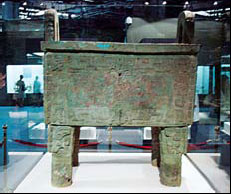
The Simuwu Ding is a square-shaped ding, or sacrificial vessel, produced in the late Shang Dynasty (BC 1600-1100). Unearthed in Anyang of Henan province in 1939, it is the largest bronze ware artifact ever found in the world.
The ding was used for sacrifices in ancient China, though it was originally used as a cooking vessel.
Weighing 832 kg, the Simuwu Ding is 133 cm in height, 110 cm in length and 79 cm in width. A Shang emperor produced it to worship his mother. Its name, Simuwu, is inscribed on the inside wall of the vessel.
The engraved cloud pattern on the surface of the body is meticulous, the two tiger-head carvings on both ears are dignified and the beast-faces on the four feet are amazing.
Simuwu Ding represents the highest level of bronze cast technology in the Shang and Zhou (BC 1100-221) dynasties.
"One of the two ears on the vessel was lost when it was unearthed," says Qi Jixiang, a senior museum guide, who has worked in the National Museum since the late 1950s and retired years ago. "After the vessel was transported to the National Museum in 1959, specialists made a replica according to the design of the other ear on the vessel."
"Because of its weight and issues of preservation, the vessel has hardly been seen by the public. Even the one sometimes shown in the National Museum of China is a replica," Qi says.
Besides the Simuwu Ding, there is plenty else to see.
For example, the Four Ram Zun Vessel, weighing 34.5 kg, was found in Hunan province. Its history dates back to the late Shang Dynasty.
"Pictures of the Simuwu Ding and the Four Ram Zun are in my history books," says Han Jingyan, a middle school student. "It's so rare to see them."
Other highlights include exquisite robes worn by Qing Dynasty (1644-1911) emperors, century-old silk weaving and dyeing products, the famous Zenghouyi bronze chimes of the early Warring States Period (BC 475-221), a collection of poems compiled by Song Dynasty official scholar Zhu Xi (1130-1200), and rarely-seen blue and white porcelain products from the Yuan Dynasty (1206-1368).
10 am-5 pm. The National Science and Technology Museum of China, 5 Beichen Donglu, Chaoyang District. 6237-1177