The logo of the Beijing 2008 Olympic Torch Relay owes much of its inspiration to the traditional concept of "fire phoenix", and presents the image of two runners holding the Olympic Flame high. As ancient Chinese legend has it, phoenix is the king of all birds, and symbolizes good fortune, eternity, nobility and happiness. The use of the phoenix image in the Torch Relay logo conveys the idea that the Torch Relay will send the best wishes from the Beijing Olympic Games to people all over China and the rest of the world.

The Logo of the Beijing Olympic Torch Relay
|
The Chinese phoenix, or Fenghuang in Chinese, exists only in legends and fairy tales, with no connection with the phoenix of the Western world, which derives from Egyptian mythology. Sovereign of all birds, it has the head of the golden pheasant, the beak of the parrot, the body of the mandarin duck, the wings of the roc, the feathers of the peacock and the legs of the crane; gloriously beautiful, it reigns over the feathered world.
Images of an ancient bird have appeared in China for over 7,000 years, the earliest as Shang Dynasty (16th-11th century BC) pottery motifs, then appearing decorating bronzes, as well as jade figurines (many of the most beautiful from the Liao Period). Some believe they may have been a good-luck totem, believing that it is a totem of eastern tribes in ancient China.
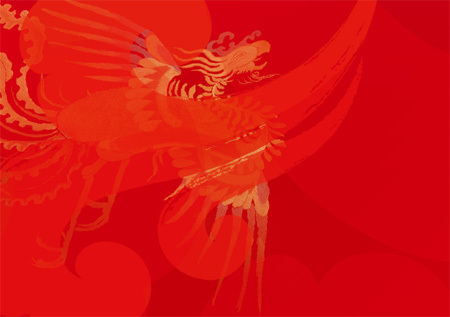
Torch Relay Graphic of the Beijing 2008 Olympic Games
|
During the Han Dynasty (2,200 years ago) two phoenixes, one a male (feng) and the other a female (huang) were often shown together facing one another. Later, during the Yuan Dynasty (1271-1368) the two terms were merged to become the generally translated "phoenix," but the "King of Birds" came to symbolize the Empress when paired with a dragon as a dragon represented the Emperor. From the period of the Emperor Jiajing (1522-66) on, a pair of phoenixes was differentiated by the tail feathers of the two birds (typically together forming a closed circle pattern -- the male identified by five serrated tail feathers (five being an odd, or yang number) and the female by what appears to be one, but is in fact, two (two being an even, or yin number) curling or tendriled tail feathers. It was also in the Ming Dynasty (1368-1644) that phoenixes first began to appear with combs, hence combless phoenixes are pre-Ming, and phoenixes depicted with combs, Ming or post-Ming.