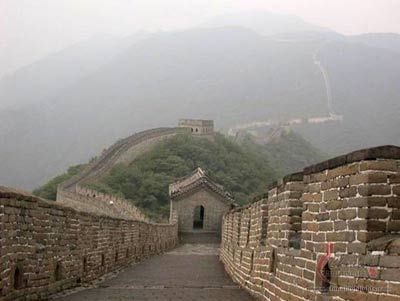
The grey Great Wall winds in mountains and grey Siheyuan courtyards lie in hutongs. The grey is the tone of traditional architectures in Beijing.
The Great Wall of China, one of the greatest wonders of the world, was enlisted in the World Heritage by UNESCO in 1987. Just like a gigantic dragon, the Great Wall winds up and down across deserts, grasslands, mountains and plateaus, stretching approximately 6,700 kilometers (4,163 miles ) from east to west of China. With a history of more than 2,000 years, it is one of the most appealing attractions all around the world owing to its architectural grandeur and historical significance.
For those who want to experience the real Beijing, the hutongs and Siheyuan (quadrangle) are indispensable and best place to visit.
Hutong means street, lane and alley, and is in fact the passage formed by lines of siheyuan (quadrangle) where most Beijing residents live. One hutong connects with another, and siheyuan connects with siheyuan, to form a block, and blocks join with blocks to form the whole city.
A hutong is an ancient city alley or lane typical in Beijing, where hutongs run into the several thousand. Surrounding the Forbidden City, many were built during the Yuan, Ming and Qing dynasties (1271-1911). In these dynasties the emperors planned the city and arranged the residential areas according to the etiquette systems. The center of the city of Beijing was the royal palace -- the Forbidden City.
A standard siheyuan usually consists of houses on its four sides, and the house which stands at the north end and faces the south is called the "main house" or "north house," the ones on both sides are called "side houses," and the one which stands at the south end and faces north is called "south house."
Not only residences but also ancient palaces, government offices, temples and monasteries were built basically on the pattern of the siheyuan, a common feature of traditional Chinese architecture. All the siheyuans, from their size and style one could tell whether they belonged to private individuals or the powerful and rich.
Hutong and siheyuan are not only a kind of architecture, but also serves as a window into Beijing folk life and the "encyclopedia of the history and culture of Beijing."