Legends in their own lifetime
China has weathered rule changes, overseas defections of coaches and players, and stepped-up competition from South Korea and Sweden in recent years, yet nothing seems capable of breaking its 50-year grip on table tennis.
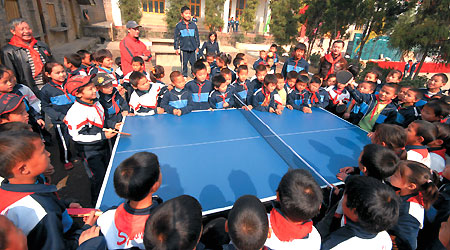
However, the sport that served China-US diplomacy in the 1970s and remains a huge source of national pride is now in danger of losing some of its appeal, some fear.
China's biggest threat could come not from opposing players, but from the global audience -- especially if it tires of predictable results, lopsided World Championships and repeat victories from veteran Chinese Olympians.
China has pocketed 16 of the 20 gold medals on offer since table tennis debuted at the 1988 Seoul Olympics, leaving only three for Republic of Korea and one for Sweden.
Since Rong Guotuan claimed the country's maiden world title in 1959, China has cleaned up at the worlds. True to form, it stole all the honors at the year-ending International Table Tennis Federation (ITTF) Pro Tour Grand Finals and the following "Good Luck" team competition test event in Beijing.
All of which makes for a slightly dull competition come August, critics say.
To enliven the Olympic tournament, the International Olympic Committee revised the format for the Beijing Games, with team events replacing the traditional doubles.
The International Table Tennis Federation (ITTF) has done much to promote the sport and make table tennis more visually appealing, with several major reforms having been implemented since Canada's Adham Sharara took over as president in 1999.
Larger balls (40mm instead of 38mm) were introduced to slow play, the scoring system was shrunk from 21 points per game to 11 ppg, and service rules were amended to prevent players from hiding the ball below the table to give themselves an edge.
As the Chinese pioneered the latter tactic, some local coaches have expressed outrage at the IAAF's changes, arguing that their sole aim was to knock the Chinese off their perch.
Which is exactly what happened -- in the beginning.
The Chinese lost some Pro Tour titles and a number of players seemed to have been affected mentally, but they soon adapted and re-established their position at the figurative head of the table.
"Each new regulation puts all of the teams back at square one, but China usually manages to continue its success," said former national head coach Cai Zhenhua. Cai now serves as vice-minister at the State General Administration of Sport, the governing body of China's sports development.
China vs. the world
More than half of the current top 20 world-ranked men's players come from the Chinese mainland, Chinese Taipei, Hong Kong and Singapore.
The others form something of an international coalition, led by Germany's Timo Boll, Vladimir Samsonov from Belarus, Oh Seung Min from South Korea, Austria's Werner Schlager, Belgium's Jean-Michel Saive and Kalinikos Kreanga from Greece.
China's women have an even tighter grip on the rankings and medals.
World No 10 Fukuhara Ai of Japan is the highest-ranked non-Chinese these days, yet even she trained in the country for many years and now plies her trade for a local club here.
In Europe, world No 29 Tamara Boros of Croatia tops the table, but she has never medaled at a high-profile international event.
The secret of success