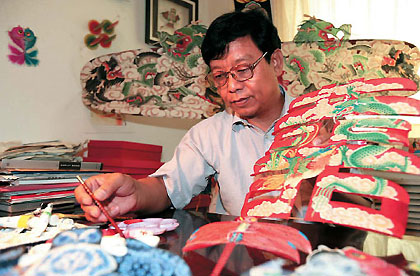
At his studio in west Beijing, Ha Yiqi is busy painting a giant dragon and phoenix kite for an American museum. On the walls hang dozens of delicate handmade kites priced from 4,000 yuan ($580) to 40,000 yuan.
"The kites made by my family are not toys or handicrafts but real pieces of art," the 43-year-old kite maker told China Daily.
"Although traditional Chinese arts have been introduced to overseas markets, the authentic pieces are still made here," he said.
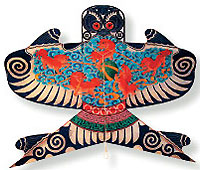
For over 150 years, the name "Fengzheng Ha" (Kite Ha) has built up a strong following in China for its colorful, cross-shaped kites modeled after swallows.
In 2001, a pair of kites designed by Ha were sent to the mayor of Moscow during Beijing's bid for the 2008 Olympic Games. Even one of the five Olympic Fuwa mascots, Nini (the swallow), is inspired by the "Fengzheng Ha" shayan kites.
To present traditional Chinese art to the world, the Olympic organizers introduced Ha's 14 framed kite collections into the official Beijing Olympics souvenir shops.
Now Ha wants to fly his Olympic dream even higher.
"I am involved in a large project with other local artists to make a 204-flag kite for the Beijing Games," he said.
The kite will be over 100 meters long and will include 203 national flags as well as that of the International Olympic Committee. All the flags measure 45cm x 30cm and will be placed in alphabetical order.
To make such a large kite fly, Ha must solve three technical problems related to frame making, covering and painting.
"My family were making huge kites before the 1930s, so I will just keep with tradition and learn from their experience," he said.
"Technically I don't have any problems."
Ha and his apprentice will make the frames and stretch the covers over them, leaving local painters to do the rest.
"It will take 1,500 hours to complete the project and it will take at least five men to fly the kite, which can carry 500-1,000 kg," he said.
The project is expected to be finished by February. In April, the giant flag will be flown in the sky of Beijing.
"We are going to donate this kite to the Beijing Games or the IOC," he said.
Chinese origins
Some 2,800 years ago, the kite was first invented by the Chinese philosopher Mo Zi and legendary carpenter Lu Ban. A paper kite recorded as being used to convey an imporant message for a rescue mission.
In ancient China, kites were used in military operations for measuring distances, testing the wind, evacuating men, signaling, and communications.
After the fall of the Tang Dynasty (618-907), kites were reinvented as a popular toy for the public.
With the efforts of four generations, Ha and his forefathers have developed kite making into a fine art.
One of Ha's forefathers, Ha Huoliang, started the business in Beijing during the Qing Dynasty (1644-1911) but it was Ha's grandfather, Ha Changying, who lay the foundation for the family business by laying down the rules of kite making.
In 1915, his "butterfly," "dragonfly," "phoenix" and "white crane" designs won silver medals at the Panama World Expo. Five years later, he made the family's largest kite measuring 800 square cm.
In the 1950s, Ha's father, Ha Kuiming, began to record the family's skills and designs. He then had to burn all of his books and tools under the "cultural revolution" (1966 -- 76) as kite making was regarded as a feudal relic.
"It took my father four days to burn all of his things," Ha recalled.
After the "cultural revolution", Ha's father tried to write another book about kite making based on memory.
Ha Yiqi started to learn the art when he was 10. At 16, he picked up oil painting.
During the 1980s, Ha quit his job at a steel factory and joined the China Beijing Kite Company.
Now he has his own company manufacturing kites and other traditional handicrafts such as lamps, T-shirts, tableware and bedding.
"What is different from my forefathers is that I turned a small family business into a cultural enterprise," he said.
But in the selection of his apprentice, Ha is very traditional.
"The rule in my family is that we pass our skills on to our sons. But I only have a daughter, so my nephew is my apprentice," he said.