|
Next most livable place?
(China Daily)
Updated: 2006-09-22 09:33
Despite roaring bulldozers, snail-paced traffic and overwhelming dust on windy days, it is believed the central-northern area of Beijing, where several main Olympic venues are being built, will be one of the most livable places in the city in the near future, according to a recent survey conducted by the Chinese Academy of Sciences.
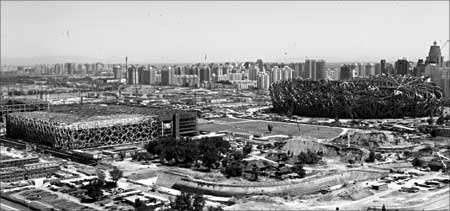
The central Olympic area under construction.[China Daily]
|
At the moment, the central Olympic district, 10 kilometres north of the Forbidden City, only ranks 91st out of 134 residential districts covered in the survey of people's perceptions of the livability of the areas, according to the survey.
The survey, with a random sample of 11,000 residents in the urban area of Beijing, was carried out to evaluate the living conditions of different areas of the city. A total of 7,647 valid questionnaires were collected.
Safety, health, convenience, amenity and sustainability were the major criteria that respondents needed to take into account when scoring the neighbourhood where they lived, said Zhang Wenzhong, a researcher of the Institute of Geographic Sciences and Natural Resources Research under the Chinese Academy of Sciences, who led the survey team.
The Jingshan neighourhood, adjacent to the Forbidden City, topped the list, while two neighbourhoods in Shijingshan District, where the major polluter Shougang Group is located, were at the bottom.
"Livable Beijing" has been a buzzword on the lips of 15 million Beijing inhabitants since the city promised to host a "green" Olympics. The city's master plan also calls for the lofty goal of becoming "a city suitable for living."
"I believe the central Olympic district will become one of top five or even top three most livable places in next two to three years," Zhang told China Daily.
The central Olympic district he mentioned refers to an area that is sandwiched between the northern parts of the Fourth Ring Road and the Fifth Ring Road. The district reaches Tangli Road in the east and extends to the Badaling Expressway in the west.
But people could be forgiven for being skeptical about whether Beijing's theoretical embrace of "livability" can be translated into real improvements in the quality of life in the Olympic district, which often feels like one enormous construction zone.
And the district's ranking is alarmingly low compared with the high expectation of a new "face" for Beijing when the Games is staged. However, this region is experiencing fundamental changes day by day, which will not only improve its own living conditions but also help its neighboring areas become more livable, Zhang predicted.
"Actually, the pace of the changes has already exceeded anybody's imagination," Zhang said, whose office is located exactly at the core of the district. "Thanks to the enormous amount of money plunged into this area, everything looks better every day. After all, money talks here."
Zhang recalled that before China won the bid to hosting the 2008 Olympic Games in 2001, the district was blurred with shabby makeshift houses and muddy alleys.
"It was a typical zone joining town and country where low-income migrant people concentrated, and the crime rate here was higher than other places," Zhang said.
But in just a few years, the slums have disappeared and awesome Olympic venues are standing up. Construction workers are laying asphalt for 20-plus new roads and digging into the earth for two metro lines that will run across the district.
"The key factors in good living conditions here will improve a lot before 2008, and the residents living in neighbouring areas, including those in the Haidian and Chaoyang districts, will also benefit a lot from the facelift," Zhang observed.
Yin Weihong, an associate professor with the Beijing Union University participating in the survey, said the central Olympic district and the so-called pan-Olympic regions have great potential for improvement in living conditions.
Local residents also expressed their confidence in the prospect of this area in the survey.
Yin said nearly 72 per cent of survey respondents said they will choose the northern part of the city as a residential area in the future, and the Olympic factor is among the major reasons for the choice.
"We can infer the future of the central Olympic district from the current conditions of the Yayuncun neighbourhood," Yin told China Daily. Yayuncun was the site of the 1990 Asian Games and it is now a major residential area adjacent to the Olympic district. Yayuncun ranked third in the livability survey.
"Yayuncun before 1990 was almost the same as the Olympic district today," Yin said. "Hosting the Asian Games brought tremendous opportunities to the development of Yayuncun, and the effect of the Olympic Games would be even greater."
However, Yin admitted that the real upgrading of living conditions in the Olympic district also depends on overall improvements in the quality of life all over the city.
Beijing's streets are clogged with traffic as the number of cars keeps soaring day after day. Air quality, after years of steady improvement, faces the risk of worsening in some categories and Beijing continues to rank among the worst cities in the world for clean air. The city's water supply is so stressed that neighbouring provinces have to send millions of cubic metres of water to the thirsty city.
"Promoting a healthy environment is one of the goals of the Olympic Movement," Yin said. "I hope the 2008 Games will bring Beijing a more efficient traffic network, a higher living quality and a greener environment."
|