You could say it comes naturally to Zhang Chenliang. Indeed, his moniker is "the man of natural history", or Bowu Jun in Chinese. This is no idle boast as the popular science blogger has 11 million followers on Sina Weibo, the Chinese equivalent of Twitter.
His latest work-a two-minute video about the "myth" of crabs-was on the "hot search" list of the micro-blogging site on Dec 17.
According to legend, male crustaceans are romantic and reliable "husbands". When danger comes, it is said, the male box crab will carry its "wife" with its claws and flee to a safe place where the female will shed its shell.
Yet, Zhang's video unveils the truth about these marine creatures. Calappa crabs, as they are called, live alone most of their life and only get together for mating, which is the same for all kinds of crabs. Also, the male Calappa stays with the female Calappa while she's shedding its shell-which marks sexual maturity-not to protect her but to make sure he's close by at this time.
Netizens were quick to comment that they were disappointed that crabs did not have such a romantic life.
The video is just an example of how Zhang shares his knowledge with netizens.
The 31-year-old Beijing native, with a master's degree in agricultural entomology and pest control from the China Agricultural University, is a project director at Chinese magazine Natural History. He's in charge of the operation of the magazine's account on Sina Weibo.
Most of his daily schedule involves answering questions raised by readers online. These can encompass entomology, zoology, botany and geography.
Zhang likes to use humor to get his message across.
Journey of discovery
Over the past five years, besides answering thousands of questions on Sina Weibo, Zhang has been devoted to researching marine animals in China and writing a series of books titled Hai Cuo Tu Biji (Notes on Illustrated Handbook of Marine Animals). The third book of the series was published recently by China Citic Press Group and Chinese National Geography Books.
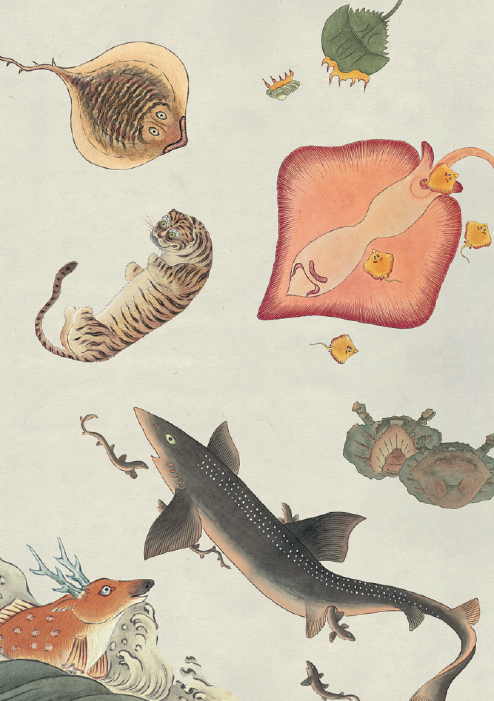
Zhang says the series is inspired by an old illustrated book, titled Hai Cuo Tu, by Nie Huang.
Nie lived in the early years of the Qing Dynasty (1644-1911). As a passionate traveler, his journeys took him from North China's Hebei province to the eastern coastal areas.
Nie painted more than 300 marine creatures he had seen or heard about during his trips over the decades and finally finished the book in 1698. The book was then introduced to the imperial court in 1726 and was admired by the emperors.
Nie's book includes four volumes-the first three are now in the Palace Museum in Beijing and the fourth one in the Taipei Palace Museum.
Zhang got his first glimpse of the fascinating book during a visit to the Beijing museum when he was in middle school.
Hai Cuo Tu, featuring the first three volumes of Nie's book, was published by the Palace Museum in 2014, and Zhang read it avidly.
A year later, Zhang decided to write a book to verify some of the creatures in Nie's book. "Nie not only wrote down what he knew or heard, but also left some questions which he hoped descendants could answer for him."
Zhang tried to answer most of the questions with his knowledge and research. He traveled to China's coastal areas and also to Japan and Thailand, visiting local markets and scholars, and read old books or theses to find the answers.
"I think Nie would be happy to read my books," he says.
Zhang published his first book in 2016, verifying 38 creatures featured in Nie's Hai Cuo Tu, and a year later, a second book was published, verifying 40 more. Both books won praise from readers, selling 260,000 and 160,000 copies respectively.
In 2017, the Taipei Palace Museum made the images of the fourth volume of Nie's Hai Cuo Tu open to the public for free, and Zhang got to verify some species from it for his third book. "I'm trying to let the marine creatures across the Taiwan Straits unite."
The third book, including 20 articles and featuring 63 marine animals, took Zhang two years to finish.
"It took longer because for the first two books, I selected the easier creatures to verify, which I already had some knowledge of and are more common," Zhang explains. "For the third book, I had to look into the creatures that were not easy to verify. Some of the creatures are only based on other people's descriptions, and may look quite different in reality."
Science education
Zhang's experience in researching insects helps him when verifying marine creatures. "Even though they are not related, the scientific ways of researching are the same."
Besides the elaborate paintings from Nie, Zhang also invites several illustrators to draw pictures for him to pair with his articles so that the readers can understand the content more easily.
Zhang says he writes each article in logical order following questions that a reader would ask.
"If I write about a pearl, besides saying that people in the Qing Dynasty started to breed pearls, I will also answer questions like 'what's the difference between a pearl in fresh water and in seawater'," he says.
"I don't want my readers to have more questions after reading my articles."
In his books, Zhang explains how some of the creatures were quite common in Nie's time but have become rare or endangered nowadays-because of overfishing or environmental destruction.
It's his way of popularizing public science education and educating the readers to protect the environment.
He is planning a fourth book.
He's also running an account on video-sharing app Douyin, known outside China as TikTok, to interact with fans.
The growing use of social media, he says, offers more opportunities to spread knowledge of nature and science.
Yet, it's important to understand how different platforms work, he adds, and present tailor-made content for each in either words or videos.
Zhang Jie, a researcher at the Institute of Zoology, Chinese Academy of Sciences, comments that Zhang Chenliang has brought the seas to life by describing major categories of marine creatures, and their characteristics, behavior and breeding.
"After reading the book, you must feel closer to the oceans," she says.




Copyright 1995 - . All rights reserved. The content (including but not limited to text, photo, multimedia information, etc) published in this site belongs to China Daily Information Co (CDIC). Without written authorization from CDIC, such content shall not be republished or used in any form. Note: Browsers with 1024*768 or higher resolution are suggested for this site.
License for publishing multimedia online 0108263 Registration Number: 130349