Exhibition marks centennial of master painter Wu Guanzhong's birth, Lin Qi reports.
Late master painter Wu Guanzhong (1919-2010) and two of his peers, Chinese-French artists Zao Wou-ki (1920-2013) and Chu Teh-chun (1920-2014), were dubbed the "three musketeers" of modern Chinese art by the media. The artists first attended the China Academy of Art in Hangzhou, Zhejiang province, and then lived and studied in France, where they learned about different art movements in Europe, and were also elected to become members of the Academy of Fine Arts of France.
They all taught at art schools. While Zao and Chu abandoned teaching after moving to Paris in 1948 and 1955 respectively and became career artists, Wu returned to China in 1950 and taught for decades before retiring from Tsinghua University's Academy of Arts and Design in the late 1980s. He lived in Beijing and painted while he also taught.
Wu educated generations of painters and art scholars, as well as through his own works helped the masses to develop a deeper appreciation for and integration of art in daily life.
|
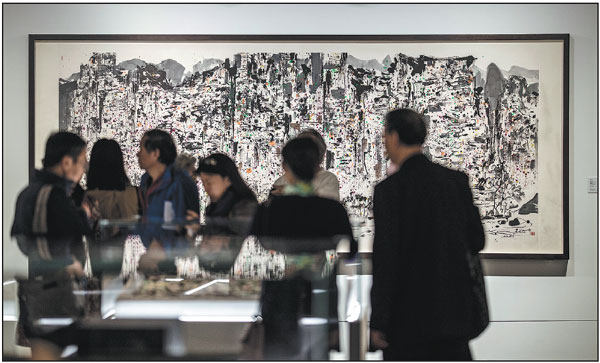
A landscape by late artist Wu Guanzhong goes on show at Art Nurtures Life, an exhibition that runs through May 3 at Tsinghua University Art Museum. Photos Provided to China Daily |
"Throughout my life I have strived to find a sentiment that could be shared by all people," Wu once said.
He is remembered as one of the most forward-looking and beloved artists in China.
Wu's commitment to public education in art is at the heart of Art Nurtures Life, an ongoing exhibition that runs through May 3, 2020, at Tsinghua University Art Museum. The show gathers collections of Wu's works from the museum, the National Art Museum of China in Beijing and the National Gallery Singapore. The exhibition is said to be a climax of several art shows and events throughout this year to mark the centennial of Wu's birth.
Wu donated his works to many museums through which he also wished to boost public education in art. A few hours before he died on June 25, 2010 in Beijing, five of his paintings arrived at the Hong Kong Museum of Art to complete the last donation made during his lifetime.
The exhibition now on at the Tsinghua University Art Museum includes dozens of paintings, drafts, manuscripts and objects used by Wu that were donated to the museum by Wu's family in July and earlier this month.
Wu Keyu, the artist's eldest son, says the donations fulfill the wish of his father who anticipated a museum being built at the university he had served for decades.
Among the exhibits is Last Spring, an ink work in color from 2010 in which Wu Guanzhong administered a combination of lines and dots to present a vibrant scene of spring in an abstract way.
Wu Yiding, the youngest son, says the painting is the last completed work in the artist's oeuvre.
The ailing Wu Guanzhong was sent to hospital shortly after he finished the painting.
"Father didn't have the time to sign or stamp his seals on it, neither did he get the piece framed," Wu Yiding says. "He was hospitalized for 85 days. He never returned home to his studio."
In his body of works, Wu Guanzhong hailed the beauty of forms. He choreographed a symphony of lines and dots between strokes, aided by layering a light, refreshing palette, to deliver rhythmic poetry.
Wu Guanzhong is known for bringing East and West closer together through his work. He was trained at Ecole nationale superieure des Beaux-Arts in Paris in the 1940s. He often said he wanted to be a man of "mixed blood in art" to fuse the essence of the two cultures.
Wu Guanzhong adopted the techniques and color schemes of oil paintings to reform the style of classic Chinese ink paintings. He was also inspired by the natural scenery and ancient architecture from his native country to create oil works that are exuberant with an elegant, philosophical touch of Chinese culture.
"Day and night, I stand firmly on the soil of my home, and I embrace the motherland, feeling her warmth and pulse all the time," he said.
Zhang Fuye, a former student of Wu Guanzhong and currently a professor at Tsinghua University's Academy of Arts and Design, says his teacher asked them to learn about Chinese art traditions and absorb their essential elements, and he especially spoke highly of the poetic atmosphere and philosophical depth conveyed in classic landscape paintings.
"A serious, upright man, he shouldered a strong responsibility for the development of Chinese art and culture," Zhang says.
Wu Guanzhong once said he hoped his paintings would be praised by his former teachers and artist friends in France, while also pleasing ordinary viewers like rural women with little knowledge of art.
He said, "If people miss me, just go to see my paintings."




Copyright 1995 - . All rights reserved. The content (including but not limited to text, photo, multimedia information, etc) published in this site belongs to China Daily Information Co (CDIC). Without written authorization from CDIC, such content shall not be republished or used in any form. Note: Browsers with 1024*768 or higher resolution are suggested for this site.
License for publishing multimedia online 0108263 Registration Number: 130349