City's last remaining bricks-and-mortar clothes repair shop struggles on
Clothes repair shops are a rare sight in Guangzhou these days.
The advent of fast fashion and e-commerce have changed buyers' habits in the capital of Guangdong province, with many now preferring to buy new clothes rather than having their old garments mended.
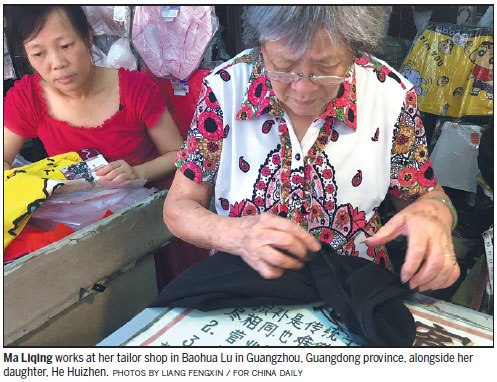
Ma Liqing's place, in Baohua Lu, is the last of its kind in the city - a shop that carries out repairs by hand. The 87-year-old shares 12 square meters of retail space with her daughter, who sells underwear.
Business may be slower than it once was, but seven decades of trade have earned Ma some loyal customers.
"After all these years, we have many old patrons. They come from other countries, from Shenzhen and Zhuhai," she said, as she sat in her sparsely decorated store, mending a nylon dress adorned with traditional Chinese patterns.
"We used to have more orders than we could finish, but business has decreased markedly in the past few years. People only bring expensive clothes now."
As a teenager, Ma would make money by knitting for some of the stores along Baohua Lu. That was before she met her husband, whose clothes repair shop specialized in mending qipao (a traditional Chinese dress), Western-style suits, cashmere jackets and stockings, among other clothes and accessories.
In 1958, the couple's store was merged with eight others and moved to its present address as part of a reorganization of the city's commercial sector.
Three decades later, as China was embracing reform and opening-up, clothes repair enjoyed something of a boom time.
"Dacron shirts, which appeared in the 1970s, were expensive then. Some customers brought us their Dacron shirts that they had worn for over 10 years to get repaired," Ma said.
"Nowadays, young people just buy new clothes if their old ones break. They have no concept of mending things."
At its height, Ma's store could count Guangzhou's fivestar hotels among its clients and was entrusted with repairing their valuable sofa covers and tablecloths.
Sometimes she even had to take bags of clothes home with her and ask her two daughters for help, as there were not enough hours in the day to get everything done.
"Some clients scolded us if we could not finish the work on time," she said.
Things are different now. The big hotels don't send orders anymore, and Ma mostly works alone - her husband died in 2003 and the eight people who used to work alongside her have all retired.
She underwent cataract surgery a few years ago, which improved her eyesight and allowed her to continue in her job, plus her daughter-in-law helps out at the shop every three days or so.
"It takes several hours to fix a piece if the texture is complex. New fabrics come to the market, but it's more or less the same. You just mend them according to their texture. Nylon and loose fabrics are more difficult, but you do what you can," Ma said.
"It is my job, but it's not easy and most young people would not bother to learn it."
One of her customers, surnamed Feng, came into the store while Ma was chatting to collect an expensive sweater that belongs to her husband. It had a small hole, which Ma fixed for 25 yuan ($4).
"You can't find any stores like this in Guangzhou anymore. It's not like a tailor's shop. When clothes are darned they look as good as new - a sewing machine can't do that," Feng said.
"It's beautifully done. My husband will like it."
A traditionalist at heart, Ma still takes orders using the bamboo tiles covered in Chinese characters that her son made for her 50 years ago. The tiles come in pairs, with one kept by Ma and the other by the client, who presents it when their clothes are ready for collection.
She said she has never lost a single piece of clothing, but still has many mended items that clients have failed to collect.
If it weren't for her daughter's underwear business, Ma wouldn't be able to afford the 5,000 yuan monthly rent on the shop. He Huizhen, the daughter, works alongside her mother to make sure nobody tries to pay with fake notes.
She said when Ma retires, she plans to close the store - spelling the end of an era for such businesses in Guangzhou.
Liang Fengxin contributed to this story.
liwenfang@chinadaily.com.cn




Copyright 1995 - . All rights reserved. The content (including but not limited to text, photo, multimedia information, etc) published in this site belongs to China Daily Information Co (CDIC). Without written authorization from CDIC, such content shall not be republished or used in any form. Note: Browsers with 1024*768 or higher resolution are suggested for this site.
License for publishing multimedia online 0108263 Registration Number: 130349