NAGOYA, Japan - The sound of bodies slapping against each other rocks the stifling sumo "stable" in the Japanese city of Nagoya, as 11 gigantic wrestlers wearing only loincloths take turns throwing each other out of a ring of sand.
The wrestlers, or "rikishi", at the prestigious Tomozuna stable spend more than three hours each morning practicing holds in Japan's ancient national sport, with defeat facing the first to fall or be forced out of the ring.
With rare permission granted by sumo's governing body, Reuters was able to observe the stable's wrestlers training at their temporary Buddhist temple base for the Nagoya Grand Sumo Tournament that began last week, gaining insight into the intricacies of sumo.
Entering the world of sumo is to eat, live, and breathe Japanese - from the samurai-style topknots to the rigid hierarchy.
But the tough training and tradition-bound ways have put off many Japanese youth, leaving sumo to be dominated by foreign - mostly Mongolian - wrestlers, who face a grueling path to assimilation.
"Language was the biggest source of stress," said Tomozuna Oyakata, better known by his fighting name Kyokutenho, the first Mongolian-born wrestler to lead a sumo stable.
"I couldn't understand anything when I was being scolded, or even when I was being praised," said the master, one of the first six Mongolians to be inducted into the sport in 1992.
Today, the one-time champion, who was born Nyamjavyn Tsevegnyam, speaks near-flawless Japanese, has a Japanese wife, and has given up his Mongolian nationality to become Japanese - a requirement to become a sumo master, or 'oyakata'.
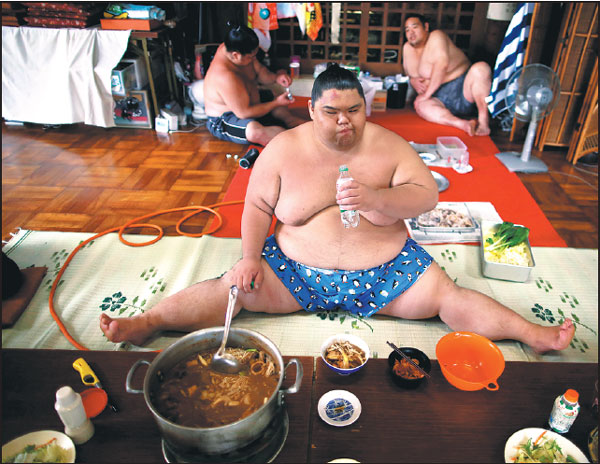
After ending practice at 10:30 am, the wrestlers mingle with fans, sign autographs and pose for photos before the first of their two daily meals.
Lunch, prepared by the junior wrestlers, is a spread of pig's feet, grilled and deep-fried sardines, steamed rice, and 'chanko nabe' - a signature hot-pot dish associated with sumo wrestlers, who are said to consume 8,000 calories a day.
The wrestlers nap for several hours immediately after eating, wearing oxygen masks to aid breathing.
Full assimilation into Japanese culture means that foreign wrestlers face no ill-will.
"We wear our topknots, kimonos and sandals, and live by Japanese rules, and the rules of sumo," said Tomozuna Oyakata.
"It's only by chance that we were born a different nationality."
Reuters
|
Sumo wrestler Kaiho eats a "chanko" meal in the main hall of Ganjoji Yakushido temple, in Nagoya, Japan. The temple is used by sumo wrestlers belonging to the Tomozuna stable as a temporary base for the Nagoya Grand Sumo Tournament.Issei Kato / Reuters |




Copyright 1995 - . All rights reserved. The content (including but not limited to text, photo, multimedia information, etc) published in this site belongs to China Daily Information Co (CDIC). Without written authorization from CDIC, such content shall not be republished or used in any form. Note: Browsers with 1024*768 or higher resolution are suggested for this site.
License for publishing multimedia online 0108263 Registration Number: 130349