Industry scales back overproduction, saving energy and conserving water, according to expert
China's iron and steel business is scaling back on over production and clamping down on pollution.
An industry insider confirmed the shift, as the sector brings in high-tech solutions to grapple with old practices.
"The industry has improved greatly in saving energy, reducing pollution and water waste," said Li Xinchuang, president of the China Metallurgical Industry Planning & Research Institute. His comments came at the Eighth China Iron & Steel Energy Saving and Emission Reduction Forum in Beijing on Saturday.
|
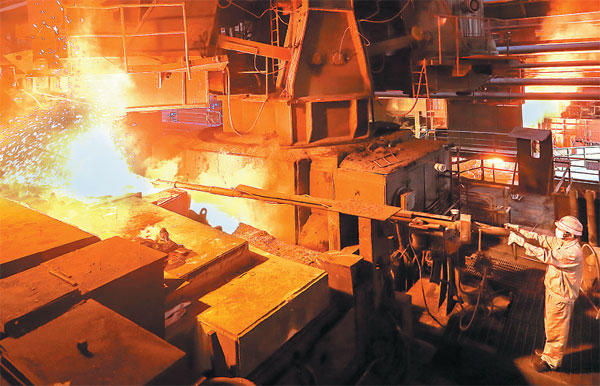
A man makes steel at a factory in Ma'anshan, Anhui province. Zhang Mingwei / For China Daily |
As a pillar industry, the iron and steel sector accounts for about 15 percent of the total carbon emissions in the country.
During the last decade, the industry has reduced its coal use by 34.4 million metric tons after bringing in energy-saving production processes, Li, also a vice-chairman of the China Iron and Steel Association, pointed out.
A glance at the figures showed that China's crude steel output jumped 108 percent between 2007 and 2016, with an annual increase of 7.6 percent.
Total energy consumption by the industry during that period grew only 93 percent, with an annual increase of 6.8 percent, according to statistics from the China Metallurgical Industry Planning & Research Institute.
Sulfur dioxide emissions per ton of steel also fell to 0.69 kilogram last year from 3 kg in 2005. Dust emissions per ton of steel were down to 0.75 kg by the end of 2016 from 2 kg levels 20 years ago.
"By implementing projects such as sintering flue gas, desulfurization and using gas instead of coal, air pollution has been greatly reduced," Li said.
Waste water discharged during the steel making process has also been reduced.
From 2005 to 2016, the total amount of waste water from the industry fell by 800 million cubic meters, from 1.2 billion cu m to 400 million cu m, data highlighted.
The amount of waste water discharged from making one ton of steel was down to 0.8 cu m in 2016 from 4.7 cu m in 2005.
Some companies even reported figures close to zero percent when it came to discharging waste water.
"In addition, solid waste has become less of a problem," said Li at the forum.
But there is a significant difference between companies when it comes to environmental protection.
Li stressed that major players such as Baowu Steel Group, Taiyuan Iron and Steel Corp, and Tangshan Iron and Steel Co have made major inroads into curbing pollution.
The cost of producing one ton of steel varies considerable, depending on the measures brought in to protect the environment. Statistics showed it ranged from less than 80 yuan ($11.8) to 180 yuan.
"The difference in environmental protection costs goes against the idea of fair competition in the market, and is preventing healthy development in the industry," Li said.
In 2015, the total energy consumption of China's iron and steel industry declined for the first time in nearly 30 years. The industry's comprehensive energy consumption per ton of steel has dropped to less than 580 kilograms standard coal, because of improved production technologies and equipments.
mengfanbin@chinadaily.com.cn




Copyright 1995 - . All rights reserved. The content (including but not limited to text, photo, multimedia information, etc) published in this site belongs to China Daily Information Co (CDIC). Without written authorization from CDIC, such content shall not be republished or used in any form. Note: Browsers with 1024*768 or higher resolution are suggested for this site.
License for publishing multimedia online 0108263 Registration Number: 130349