An ongoing exhibition shines light on whole-shape rubbings, a technique which creates a three-dimensional effect to show an item's shape and details on it. Liu Xiangrui reports.
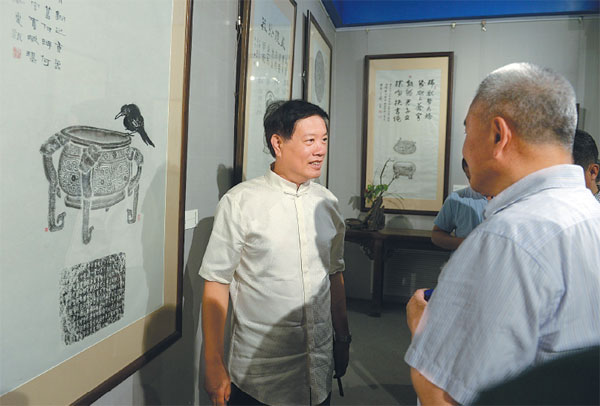
More than 60 rubbings of ancient bronze ware and other relics by Jia Wenzhong, an expert on bronze ware identification and relic repairs, are on display at Prince Kung's Mansion in Beijing.
Unlike regular rubbings that only represent the surface of relics from one side, the rubbings by Jia are whole-shape rubbings, a technique that was developed nearly 200 years ago, which creates a three-dimensional effect to show an item's shape and details on its surface.
The technique used to be very popular before photography was introduced into China and was used in epigraphy, the study of inscriptions.
|
Jia Wenzhong shows his rubbings of ancient bronze ware and other relics at an exhibition in Beijing's Prince Kung's Mansion. Photos Provided to China Daily |
"For people back then who were interested in epigraphy, they usually studied the relics through paintings and rubbings. Rubbings were much more accurate than paintings, so some experts believe that without rubbings there would be no epigraphy," says Jia.
The traditional technique is still widely used and plays an important part in archaeology, the 56-year-old adds. Jia was born into a family in Beijing that for generations was devoted to repairing cultural artifacts, especially bronze ware, and he mastered the skills to create whole shape rubbings during his long relic repair career.
Among the pieces on display in the exhibition are rubbings of famous bronze pieces such as the Boju Ge, an ancient three-legged bronze vessel used for sacrifices that was unearthed in Beijing in 1974, but which dates back to the Western Zhou Dynasty (c.11th century-771 BC).
The Boju Ge rubbing, which is regarded as one of Jia's representational works, was given to former French president Jacques Chirac as a present by China in 2011.
Although he had worked on many important bronze pieces before, Jia says, it was still a great honor for him to have a chance to do a rubbing of the Boju Ge, which is a national treasure.
To make a rubbing, he carefully measures the bronze ware and chooses the best angle to present the piece on paper. He makes line drawings of its different parts, using a special kind of paper, and these are then separately laid on different parts of the item to be rubbed. Then the rubbing, which involves several steps, is carefully done to capture the patterns in ink. The papers bearing the patterns are finally pieced together on a sheet of paper to complete the whole-shape rubbing.
"It took me a whole week of careful work to complete the Boju Ge piece," he recalls.
The exhibition is in three parts: Jia's whole-shape rubbing technique, his rubbings of bronze ware themed on zodiac animals, and an introduction to his family's contribution to epigraphy.
The exhibition runs till July 17.
Jia has been involved in cultural relics repair work since the late 1970s, and has made significant contributions to the inheritance and promotion of the traditional whole-shape rubbing technique.
Currently Jia is making efforts to pass on the old technique to students who major in cultural relics' protection and scientific archaeology at Beijing Union University.
"Now I have two master's students who are studying whole-shape rubbing," says Jia, adding that he is preparing to apply for the craft to become national intangible cultural heritage.
Contact the writer at liuxiangrui@chinadaily.com.cn




Copyright 1995 - . All rights reserved. The content (including but not limited to text, photo, multimedia information, etc) published in this site belongs to China Daily Information Co (CDIC). Without written authorization from CDIC, such content shall not be republished or used in any form. Note: Browsers with 1024*768 or higher resolution are suggested for this site.
License for publishing multimedia online 0108263 Registration Number: 130349