Project aims to preserve buildings not eligible for official protection
Wuyuan, a county in East China's Jiangxi province renowned for its pastoral beauty, has found a novel way to breathe new life into centuries-old houses that have fallen into disrepair.
Many of the buildings' owners lack the funds or skills to do the work themselves, so outsiders are being encouraged to "adopt" the rundown houses and have them renovated - even turning some into stylish boutique hotels, sought after by tourists from across the country.
The project aims to complement a recent building protection drive, which listed key buildings that needed to be maintained. The buildings up for adoption did not make it onto the official list because they are not old enough to be eligible for government-funded protection.
Wu Zhixuan, 41, was the first outsider to rent and renovate a house in Wuyuan. He turned it into a village inn.
When Wu first visited Wuyuan in 2008, he said he was taken aback by the abundance of Hui-style architecture, which can be seen across East China in stately homes, ancestral halls and memorial archways.
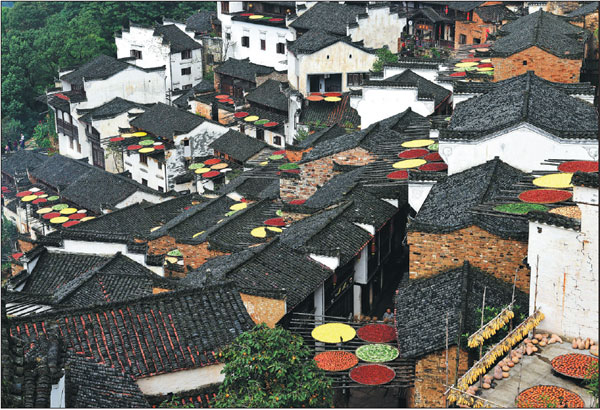
Many houses in the county feature the gray tiles and white walls associated with the technique, but are in various states of disrepair.
Because he has a degree in civil engineering, Wu felt it was his civic duty to stay and do something, he said.
So he rented the 500-square-meter house Jiusi Hall in Luoyun village on a 40-year lease for 800,000 yuan ($118,000). Built in 1902, it features two halls, a kitchen and a backyard.
"It looked good but was in a bad state of repair," said Wu, recalling that the second floor of the house had collapsed when his friend tried to film up there.
"My friend was so cool about it, he just held on to a beam," he said, laughing.
In 2011, Jiusi Hall opened to the public after a 1 million yuan refurbishment that preserved many of the original features, including the wooden doors, brick walls, paved courtyard and elegant wood carvings.
Wu added modern amenities to the house, such as soundproofing, air conditioning and modern bathrooms.
Little did he know that his renovation project would be the start of a house-adoption craze.
Wuyuan has more than 4,000 ancient houses, many built over a period of 600 years, up to the end of the Qing Dynasty (1644-1911).
So far, more than 110 of the county's houses have been rented or purchased by outsiders.
The houses up for adoption are not covered by government protection grants, and repair and maintenance fees for each dwelling can reach millions of yuan.
Moreover, it is difficult to find traditional craftsmen to renovate them. "My heart was broken when I saw these excellent examples of architecture disappearing," said Yu Youhong, a woodcarver.
Edward Gawne, 32, was the first foreigner to purchase a building in Wuyuan. With the help of Yu, he has just completed renovations on a Qing Dynasty house.
The 600-sq-m compound in Yancun village was built more than 200 years ago. When the Briton first saw it, many of the building's wooden carvings were damaged and its structural integrity needed attention.
Gawne, who comes from London, worked alongside his Chinese wife, Liao Minxin, to turn the house into a family inn. "We restored it and decorated the rooms with modern elements to make it comfortable. We also have a bar and a British-style garden," Liao said.
The house-adoption wave has also resulted in a tourism boom for Wuyuan, which covers an area of around 3,000 square kilometers. Nowadays, more than 70,000 of the 360,000 people who live there are employed in the tourism industry.
Wuyuan has over 570 family inns. Critics have argued that commercializing ancient villages upsets the tranquillity of the local area.
But according to Wuyuan publicity department, major structural changes are not allowed. The county government has drafted a regulation that is under review, it said.
"Private investment is being used to renovate and preserve those ancient houses that are not classed as 'cultural relics' but are historically valuable nonetheless," said Cao Guoxin, deputy director of Jiangxi University of Finance and Economics' tourism development research center.
As for Wu, he now rents more than 10 ancient houses across Wuyuan and Huangshan in Anhui province.
But unlike investors in neighboring Zhejiang province, who often buy houses to relocate them to other places, Wu is adamant that the historical buildings should remain in their original setting.
"They only care about the aesthetics," he said. "Protection is not only about renovation but preservation of the stories behind the house and the families who came before us."
Xinhua
|
Wuyuan in East China's Jiangxi province has more than 4,000 ancient houses, many built over a period of 600 years.Hu Dunhuang / For China Daily |




Copyright 1995 - . All rights reserved. The content (including but not limited to text, photo, multimedia information, etc) published in this site belongs to China Daily Information Co (CDIC). Without written authorization from CDIC, such content shall not be republished or used in any form. Note: Browsers with 1024*768 or higher resolution are suggested for this site.
License for publishing multimedia online 0108263 Registration Number: 130349