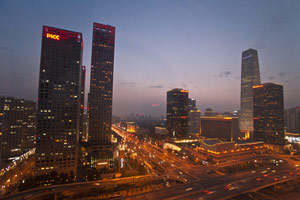
Moody's Investors Service gave the Asian Infrastructure Investment Bank its highest possible rating of Aaa, with a stable outlook, on June 29, because of "the strength of AIIB's governance frameworks, including its policies on risk management, capital adequacy and liquidity".
The Beijing-based AIIB has proved successful during its "testing the water" period. Last year, the AIIB committed a total of $1.73 billion to nine projects, achieving its loan target of $1.2 billion for the first year, which amounted to about one-fourth of the total loan committed by the International Bank for Reconstruction and Development and the International Development Association during the same period, which was $7.62 billion in total.
The success of the AIIB could be ascribed to prudential operation, a well-designed legal framework, good governance and, inter alia, the mutual trust among its member states. However, as a new multilateral development bank, the AIIB faces some significant challenges, and it has to overcome three major ones in the next stage.
The first challenge is to transform the AIIB's funding projects from "hard infrastructure" to "comprehensive infrastructure". The projects that the AIIB provided funding for last year cover a gas pipeline, two power plants, a port facility, redevelopment of a poor district, a power distribution line, a motorway construction, and railway and road improvement, which all belong to "hard infrastructure".
In contrast, the Word Bank's top nine projects cover not only hard infrastructure such as roads, electrical transmission/distribution, water supply and urban development, but also some "soft infrastructure" such as health policy and administrative management, public finance management, urban management and decentralization and support to subnational governments.
In reality, both "hard infrastructure" and "soft infrastructure" are critical to the development of Asia. To this end, the AIIB needs to expand the scope of its funding projects as early as possible to meet the demand for the comprehensive development in infrastructure in the region. In doing so, the AIIB, however, needs to maintain a delicate balance between funding for "soft projects" and not intervening in the domestic policies of the borrowing states.
The second challenge is "upgrading" of the AIIB's funding projects from "comprehensive" to "environmentally friendly" programs. Although the AIIB has taken the environmental factor into consideration while making decisions, still some projects are not environmentally friendly, such as electricity supply. To reach the global goals set forth by the Paris climate change agreement, the AIIB should better fulfill its social responsibility, by improving its environmental standards for project funding, and not allowing any environmentally unfriendly projects to receive its funds. Obviously, the consensus in this regard among the 77 AIIB members is fundamental and necessary.
The third challenge is to make the AIIB more independent in its project selection and funding. Of the nine funding projects the AIIB committed to last year, six were co-lent by the World Bank, the Asian Development Bank or other institutional investors. As co-lender, the Word Bank or ADB could undoubtedly provide assistance to the AIIB in terms of information, expertise and project management. Still, the AIIB should build up its own managerial, financial and legal teams to independently run its operations. Of course, this does not mean the AIIB should not cooperate with the World Bank, ADB or other multilateral development banks for risk distribution.
Apparently, the AIIB still needs time to get used to its business environment, in order to build up its own specialist teams and to overcome the three major challenges. But no matter how long the AIIB takes to overcome these challenges, we can expect it to play a more vital role in the world in the future.
The author is a professor at University of International Business and Economics.




Copyright 1995 - . All rights reserved. The content (including but not limited to text, photo, multimedia information, etc) published in this site belongs to China Daily Information Co (CDIC). Without written authorization from CDIC, such content shall not be republished or used in any form. Note: Browsers with 1024*768 or higher resolution are suggested for this site.
License for publishing multimedia online 0108263 Registration Number: 130349