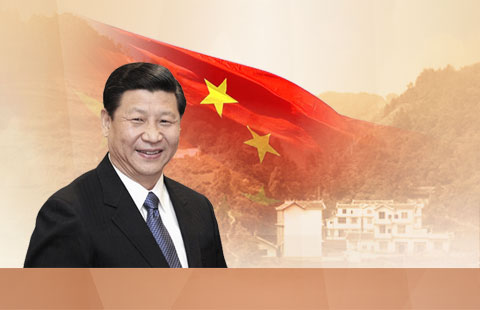
On China's diplomatic chessboard the significance of Germany and other European Union member states can be gauged from the frequent visits President Xi Jinping has paid to those countries. In fact, he is due to arrive in Berlin on Tuesday to pay another state visit to Germany, during which he will also attend this year's G20 summit in Hamburg.
China has always attached great importance to Germany.
This is Xi's second state visit to Germany after his previous one in March 2014. What's more, the Chinese president's visit this year follows just one month after Premier Li Keqiang's tour to Germany. And Li also paid a visit to Germany in 2014.
Germany attaches equal importance to China, and German Chancellor Angela Merkel has visited China many times during her term in office. Actually, an official in the chancellor's office said Merkel probably doesn't attach such importance to any other country.
Germany is a competitive exporter and manufacturer, and thus an ideal model for China. Its social welfare and market system have been widely debated in China, which is undergoing market-oriented reform. And for decades, Germany has had a big share in China's market. For example, German car brands, such as Volkswagen, Audi, BMW and Mercedes, are omnipresent in China.
And since Chinese investors have just started to explore the opportunities in the high-end product market, Xi is likely to discuss with German leaders how to further boost bilateral ties and become bigger players in each other's markets by removing trade and investment barriers.
Globalization faces increasing challenges, especially with the United Kingdom's departure from the EU and US President Donald Trump's inward-looking policy to "make America Great Again", which is nothing but trade protectionism.
Trump has also pulled the United States out of the global climate change agreement, which almost every UN member state welcomed and signed in Paris in 2015.
Germany has been championing free trade, closer global connectivity and remains committed to fighting climate change. And at the World Economic Forum in Davos, Switzerland, in January, Xi affirmed China's commitment to globalization and free trade, a commitment EU commentators and politicians alike have repeatedly cited and welcomed.
For China, Germany is not only a market but also a platform to explore the entire EU economy. In recent years, Beijing has been viewing Sino-German ties beyond the two countries' markets, whose consumers add up to 1.9 billion.
That's one of the reasons Xi proposed the Belt and Road Initiative in 2013. And Germany's positive response to the initiative prompted other EU countries to join it. For example, China initiated the Asian Infrastructure Investment Bank, which many EU countries joined as founding members to explore more opportunities in third-party markets.
Xi's visit to Germany is of great importance to EU-China ties. China has higher hopes of establishing better relations with the EU as a whole.
Xi's visits to Germany and other EU countries indicate China's sincerity in developing closer partnership with the European bloc.
As the host of the G20 summit, a platform where global issues are discussed, Germany needs support to ensure the success of the event. And Xi, who hosted G20 Leaders Summit in Hangzhou in September last year, is expected to provide that support.
The author is deputy chief of China Daily European Bureau. fujing@chinadaily.com.cn




Copyright 1995 - . All rights reserved. The content (including but not limited to text, photo, multimedia information, etc) published in this site belongs to China Daily Information Co (CDIC). Without written authorization from CDIC, such content shall not be republished or used in any form. Note: Browsers with 1024*768 or higher resolution are suggested for this site.
License for publishing multimedia online 0108263 Registration Number: 130349