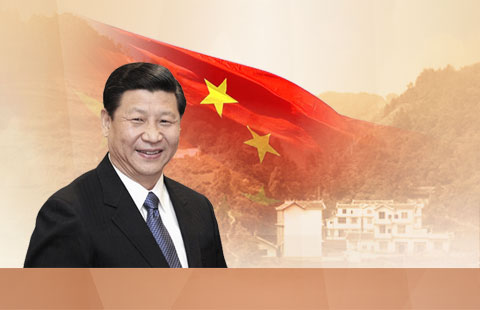
The success of the Belt and Road Initiative, proposed by President Xi Jinping, depends on efficient and timely completion of projects, which in turn hinges on the honesty of the people entrusted with executing the major tasks in the projects.
China, in fact, has done more in the past three years to bring corrupt officials to justice than was seen during the previous 30 years. And China's unprecedented crackdown on corruption will, to a very large extent, ensure people honestly and sincerely execute the projects not only along the Silk Road Economic Belt and the 21st Century Maritime Silk Road but also under other programs.
However, care needs to be taken to ensure the anti-corruption campaign doesn't slow down the speedy pace of decision-making in China. Officials are human and thus cannot be infallible.
It's a good sign that the Party and the government have begun to emphasize the importance of being sincere for those holding responsible positions. But officials need to be secure that the unintentional minor mistakes they make, or the problems caused by circumstances beyond their control, will not be used by the higher authorities to punish them.
Of course, those officials making too many bad or late decisions should be assigned to perform other, lesser, tasks, while efficient officials should be rewarded. Also, the government should issue clear guidelines for recruitment, promotion and evaluation of officials and other personnel. Only with such supplementary measures to ensure timely and high-quality implementation of decisions and policies can the anti-corruption campaign achieve total success.
China has punished far more dishonest officials than India, but this is reflective of the different political systems in the two countries. Indian Prime Minister Narendra Modi shares President Xi's views that improving governance is a prerequisite to boosting economic performance and improving public welfare.
Apart from making concerted efforts to hold corrupt officials to account, the Indian government is also harnessing technology, especially information and communications technology, to curb corruption in the administrative machinery. The more processes go online the more transparent they will become and the greater will be the degree of honesty in the implementation of policies.
China has become a global internet power thanks in part to giants such as Baidu and Alibaba. It is therefore in a position to use digital systems to promote speed along with honesty in decision-making on a much larger scale than India, where internet coverage and bandwidth are still below desirable standards. Modi has initiated several changes in the administration, though, by appointing personnel from the private sector to administrative posts.
In India, many officials still believe that they are the masters of the people.
In much the same way in China, because of the strong actions taken by the Chinese leadership with Xi at its core against even very high-level officials found guilty of corruption, the false pride of some officials is waning. The officials have realized their duty is to serve the people and not be served by the people. And the introduction of strict accountability criteria for high-level officials has been a welcome side effect of China's anti-corruption campaign.
Overall, the use of technology and the strengthening of the accountability system will ensure a better future for China and India both. Certainly the road ahead for them is hard and long. But China and India have to walk that road to fulfill the historical task as the two fastest growing developing countries.
And hopefully, rather than being rivals like the European powers in the previous centuries, China, India and the United States will learn from the European Union member states how to work together for the benefit of the entire international community.
The author is a professor of geopolitics at Manipal University, India.




Copyright 1995 - . All rights reserved. The content (including but not limited to text, photo, multimedia information, etc) published in this site belongs to China Daily Information Co (CDIC). Without written authorization from CDIC, such content shall not be republished or used in any form. Note: Browsers with 1024*768 or higher resolution are suggested for this site.
License for publishing multimedia online 0108263 Registration Number: 130349