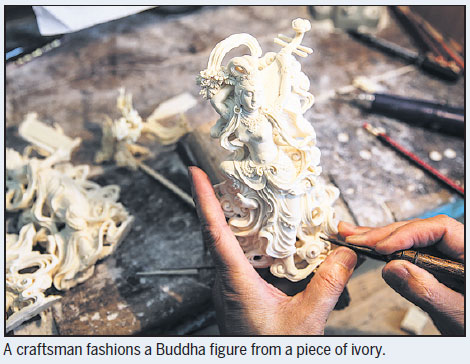
Ivory carving is one of the unique charms of Chinese carving, and has a history of thousands of years. The heyday occurred during the Qing Dynasty (1644-1911).
The craft gradually focused on small objects, which produced many of the best examples of the genre.
Most of the pieces are treasures of appreciation and ornamentation. They are decorated with scenes from scholarly stories, flower-and-bird patterns, and auspicious subjects related to cultural tastes.
The carvings were highly favored by scholar-bureaucrats, officials and aristocrats.
The artworks handed down from ancient China surpass all others in the international market, mainly because of their delicate carving and the value of the ivory itself.
Academically, Qing-era ivory carvings are categorized into two schools; the Northern style, based in Beijing, and the Southern style, based in Canton, which is now Guangdong province.
The imperial workshops of the 18th century were the birthplaces of typical Northern works, which assimilated a variety of styles and also incorporated the Canton style of carving.
Under the patronage of the emperor and dictated by his taste, court artisans created a unique style of carving that highlighted the ivory's natural attributes and stressed polished textural effects.
The designs were a good mix of elaboration and restraint. Whiile simple designs were intended, the object was to achieve the smoothest possible grinding and polishing.
Typical Northern pieces featured the Buddha, royal servants, religious figures and flowers. The Canton style focused on the proficiency of the workmen, who bleached their ivory white.
From the 17th century, the trade between East and West became increasing prosperous. Situated on the coast of South China, Guangzhou in Guangdong was a major port for foreign traders.
The style's craftsmanship is unequalled and distinctive, especially motifs featuring layered concentric balls, ivory boats and microcarving.
The record number of layers inside an ivory ball of 13 centimeters in diameter is 57. The layers, which all rotate, are covered with delicate hollow patterns.
Ivory boats were usually carved from a single tusk and were famous for the microcarvings that adorned them. Some featured 500 to 600 carved figures about 1.5 centimeters in height and all with different clothing and hairstyles.
Source: the China arts and crafts association Guangdong folk art museum




Copyright 1995 - . All rights reserved. The content (including but not limited to text, photo, multimedia information, etc) published in this site belongs to China Daily Information Co (CDIC). Without written authorization from CDIC, such content shall not be republished or used in any form. Note: Browsers with 1024*768 or higher resolution are suggested for this site.
License for publishing multimedia online 0108263 Registration Number: 130349