Large harvests of Chinese crops planted in Africa have raised hopes on the continent of greater grain yields to combat food shortages, Chinese scientists say.
"Trial plantings of quality Chinese crop varieties, including wheat, rice, corn, sweet sorghum and grapes, in Kenya, Ethiopia, Uganda, Sudan and other countries have shown promising results," says Wang Qingfeng, director of the Sino-Africa Joint Research Center in Kenya.
He says the results have been especially good in Kenya. With about 6.7 hectares of demonstration farmland, the center has conducted trial planting of high-yield corn for three years after variety screening and research. The yield of sweet sorghum has increased by 40 percent in trial planting, while hybrid rice has yielded an average 6,000 to 7,500 kilograms per hectare, four to five times the yield of local varieties, he says.
|
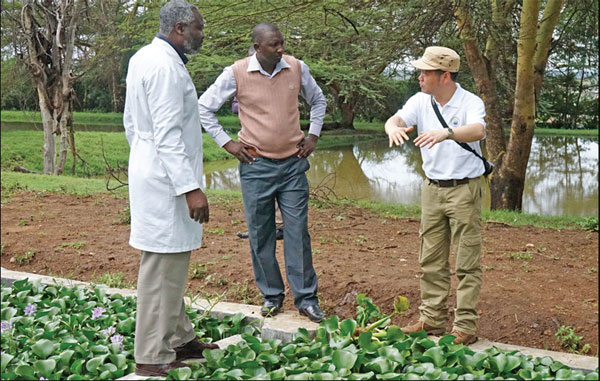
A testing field at Maasai Mara University in Kenya. Provided to China Daily |
Researchers at the center have collected some local varieties of rice, wheat and sorghum for gene sequencing to develop crops that could suit the local soil and climate, he says.
Further screening is still needed to determine the varieties for promotion after more comprehensive research into local environment and trial planting. But to help start production as soon as possible, the Kenya center has applied to China's Ministry of Commerce to establish a Sino-Kenyan modern agricultural demonstration and training center, he says.
The demonstration and training center will be responsible for screening and bringing in high-yield crop varieties, demonstrating latest planting techniques and training talents of agricultural production and product processing to improve the agricultural production capacity in Africa, says Wang.
The center has signed cooperation agreements with some Chinese agricultural companies, including Hubei Provincial Seed Group, to help in technology achievement transformation, demonstration and promotion and will seek cooperation with more companies.
China has helped African nations when their grain harvests have been affected by drought, but what the research center is doing represents a change to this aid strategy. The new model gives more "soft aid" that features technology and management approaches, says Wang, who is also deputy director of the Chinese Academy of Sciences' Wuhan Botanical Garden.
"The change better meets the need of African people and could enhance understanding and trust of them with Chinese people and deepen the friendship," he says.
The research center, which was opened in September at Jomo Kenyatta University of Agriculture and Technology, focuses on biodiversity protection, remote resources sensing, microbiology and the promotion of modern agricultural practices.
It covers 4,300 square meters and comprises a botanical garden, state-of-the-art laboratories, herb ariums, greenhouses, administration offices and conference and accommodation facilities. The Chinese Academy of Sciences supports its management and has provided equipment worth more than $2.2 million.
Meanwhile, Chinese agriculture experts have also been making efforts to increase the yield of rice in Ethiopia.
With funding from the Chinese government, a base for rice experiments and demonstration was established in February in the Werer Agricultural Research Center in Northeast Ethiopia's Afar region, which is affiliated with Ethiopia Institute of Agricultural Research and is 278 kilometers away from the capital, Addis Ababa.
With high temperatures and abundant sunshine, Werer is crossed by the Awash River, the longest in Ethiopia, and is an area suitable for rice planting. The conditions, however, haven't been efficiently used. Rice is planted on dry farmland instead of paddy fields for only one season a year during the rainy season, making yields low, says Luo Xueyi, a Chinese expert who led construction of the base.
Rice has been grown in Ethiopia for more than 40 years, but only about 53,500 hectares of the crop is planted each year in the country with a population of about 99.4 million. With the population on the rise, grain requirements are increasing, while the yield of teff, the main ingredient for Ethiopia's traditional main food, injera, is only about 100 kilograms per hectare. Rice has been listed by the Ethiopian government as an important grain to replace teff and ensure food security, says Luo.
Contact the writer through houliqiang@chinadaily.com.cn




Copyright 1995 - . All rights reserved. The content (including but not limited to text, photo, multimedia information, etc) published in this site belongs to China Daily Information Co (CDIC). Without written authorization from CDIC, such content shall not be republished or used in any form. Note: Browsers with 1024*768 or higher resolution are suggested for this site.
License for publishing multimedia online 0108263 Registration Number: 130349